Senad eradicates 57 hectares of cannabis in Piray, Capitán Bado
Paraguayan anti-drug agents eradicated 57 hectares of cannabis crop and dismantled six clandestine camps at Piray, in Capitán Bado district, Amambay, in an operation named Toro Expo. Senad said the 15-parcel complex would have produced some 170 tonnes of marijuana for the Brazilian market, and its head put the economic loss at USD 25.6 million.
Agents of Senad’s Regional Department No. 1, with support from the agency’s
Special Forces, carried out the operation named Toro Expo at Piray, in Capitán
Bado district, Amambay department.[1]Senad is Paraguay’s Secretaría Nacional
Antidrogas, the national anti-drug agency, and its head, Jalil Rachid, holds the
rank of minister.[2]
Following earlier intelligence work and field incursions, the teams found a
mechanised cannabis production complex of 15 interconnected parcels covering
close to 60 hectares.[1]In coordination with prosecutor Celso Morales, they
eradicated57 hectares of cannabis in the growth stage.[1]They also
dismantled six clandestine camps used as shelters, logistics bases and
collection centres.[2]Rachid said the plantation was fully mechanised, on
very fertile soil, which he said showed how much the criminal organisation
behind it had invested.[2]
Senad estimated the eradicated crop would have produced more than 170 tonnes of
marijuana, mainly for the Brazilian market.[1]Rachid put the economic loss to
the organisation at USD 25.6 million, and said the crop would double in price
once on the Brazilian market.[2]
Senad called the operation a decisive blow to drug-trafficking structures on the
border, sapping their production capacity and finances.[2]No arrests were
announced in the accounts of the operation.[3]
Photos and video
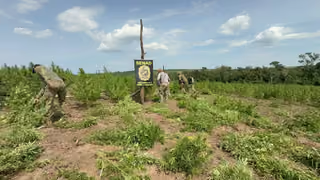
Cannabis plants in a field at Capitán Bado on 16 February 2026, in an EFE handout photo. Photo: EFE / Secretaría Nacional Antidrogas de ParaguayPhoto details
Original
780 × 520 px · JPEG · 168 KB
SHA-256
1a4503a285057642…
Retrieved
9 Nov 2026
Shown
the publisher's file, through an image proxy
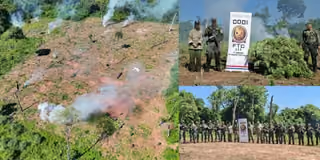
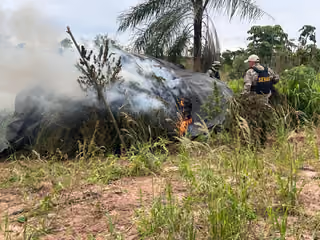
Source: Qué PasaSenad officials during the eradication of a cannabis plantation at Capitán Bado on 16 February 2026, in an EFE handout photo. Photo: EFE / Secretaría Nacional Antidrogas de ParaguayPhoto details
The accounts give no separate date for the raid beyond the 16 February 2026 publications, so the publication date stands in for the incident date.
No arrests were announced, and the reports name no suspects or organisation behind the plantation.
No count of individual plants was published; only the 57 hectares and the estimated 171-tonne production.
The 171 tonnes is Senad's estimated yield from the eradicated plots, not a weighed quantity seized.
The USD 25.6 million is Senad's estimate of the economic loss, not a sale price obtained.
The EFE dispatch places the crop in Amambay department without naming a locality; ABC Color and 1000 Noticias put the operation at Piray, Capitán Bado.
The other outlets are credited to Senad's statement, so they repeat official figures rather than independent measurements.
Senad's own statement page for Operation Toro Expo could not be opened for this report.
SENAD agents raided a rural property in Colonia Nueva Yaú, Capitán Bado, destroying 9 hectares of marijuana, 450 kg of chopped marijuana and five camps. Prosecutor Sarita Bonzi ordered everything incinerated on site while investigations continue to identify those responsible.
A joint task force destroyed three hectares of marijuana and 9,300 kilograms of the drug in the San Lorenzo community of San Pedro del Paraná, Itapúa, on 31 October 2026. Prosecutors are investigating a criminal organisation they say was buying weapons with trafficking proceeds.
SENAD’s Bella Vista Norte unit, using drones to map plots in the Timburi forest reserve, eradicated four hectares of illegal marijuana and destroyed 660 kg in 33 bales at a staging area; the agency estimated about twelve tonnes kept from the market under prosecutor Rossana Coronel’s supervision.
On 29 October 2026 Paraguay's SENAD reported eradicating four hectares of cannabis — about 12 tonnes — and destroying 1,600 kg of drying marijuana at the Indigenous colony Takua Ju in Yby Pytã, Canindeyú. No one was found at the site.