SENAD destroys 202 hectares of marijuana in Morombí over eight days
About 70 SENAD agents spent eight days in February 2020 destroying 202 hectares of marijuana in Morombí Natural Reserve, between Canindeyú and Caaguazú, and reported about 600 tonnes destroyed. They also dismantled 23 traffickers' camps and 70 charcoal kilns, and no one was detained.
🇵🇾 Morombí Natural Reserve, Canindeyú and Caaguazú · Paraguay
About 70 SENAD agents worked for eight days in Morombí Natural Reserve, between
the departments of Canindeyú and Caaguazú, and destroyed 202 hectares of
marijuana.[1]The operation was called “Canindeyú - Caaguazú I” and also
involved the National Forestry Institute (Infona), the Ministry of Environment
and the Public Prosecutor’s Office.[1]Nobody was detained during the
operation, whose procedures were led in Morombí by prosecutor Osvaldo García of
the Caaguazú anti-drug unit.[1]
In Morombí alone the agents found 50 active marijuana plots covering 202
hectares of illegal plantation and destroyed about 600 tonnes of marijuana.[1]Authorities estimated the loss to trafficking groups in the area at 18 million
dollars.[1]The agents also dismantled 23 camps set up by drug traffickers and
70 kilns where the remains of felled trees are turned into charcoal.[2]La
Nación and Mongabay Latam reported the operation on a February morning, with the
helicopter base set up on cleared land ready for grain planting.[1]
Commander Aldo Pintos of SENAD said the average marijuana plot is four to five
hectares, and that some of about 10 hectares had been found.[1]Pintos said
traffickers know the agents are coming and have already left by the time they
arrive.[1]
Satellite data showed Morombí lost nearly 4,000 hectares of tree cover between
2004 and 2019, most of it after 2014, and clearing resumed in the northern part
of the reserve after the February operation.[3]A WWF report cited by Mongabay
Latam said 9,107 hectares had been deforested in the four reserves and parks
since 2004, at least 2,350 of them for marijuana plantations.[2]
Photos and video
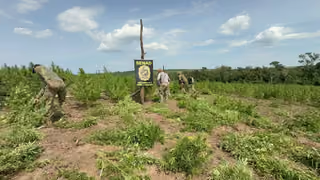
SENAD agents at a marijuana plot in Morombí Reserve during the eight-day operation that destroyed 202 hectares. Photo: Pánfilo LeguizamónPhoto details
Original
2000 × 1333 px · JPEG · 1015 KB
SHA-256
0a9f518202a36057…
Retrieved
9 Nov 2026
Shown
our 320px copy; enlarging loads the original
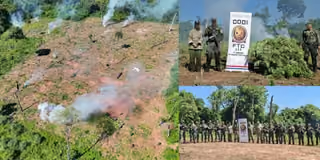
Source: Mongabay LatamMarijuana plots seen from a helicopter over Morombí Reserve, one of the areas most affected by the illegal plantations. Photo: Pánfilo LeguizamónPhoto details
Original
2000 × 1333 px · JPEG · 982 KB
SHA-256
a9e6d1d65a12191e…
Retrieved
9 Nov 2026
Shown
our 320px copy; enlarging loads the original
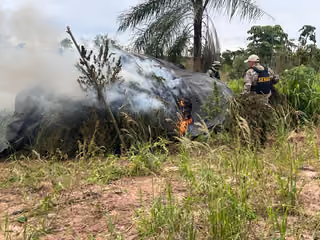
Source: Mongabay LatamClandestine charcoal kilns discovered in Morombí Reserve, where the remains of felled trees are burned. Photo: Pánfilo LeguizamónPhoto details
Original
2000 × 1333 px · JPEG · 964 KB
SHA-256
7e239c5b2e3e239c…
Retrieved
9 Nov 2026
Shown
our 320px copy; enlarging loads the original
Source: Mongabay LatamA tree felled by traffickers in the heart of Morombí Reserve. Photo: Pánfilo LeguizamónPhoto details
The sources give no exact dates for the eight-day operation; La Nación and Mongabay describe it as taking place on a February morning in 2020, and 20 February 2020 is an estimate used as the incident date.
The 600 tonnes figure is described as marijuana decomisada or destroyed; no separate weight of dried product versus plants in the field is given.
The 202 hectares, 50 plots, 23 camps and 70 kilns are given as results of the whole Morombí intervention and cannot be dated to individual days.
The 18 million dollar loss estimate is the authorities' own estimate of the harm to trafficking groups, not a market price.
Mongabay Latam and La Nación are the same journalistic collaboration, and the English Mongabay article is a translated adaptation, so the three accounts are not independent of one another.
No suspect, landowner or financier was identified or charged over the plantations, clearing or kilns.
The number of plants destroyed is not reported; only hectares and a tonnage are given.
The photographs are by the journalists' photographer (Pánfilo Leguizamón), and most captions do not say which specific plot or day they show.
SENAD agents raided a rural property in Colonia Nueva Yaú, Capitán Bado, destroying 9 hectares of marijuana, 450 kg of chopped marijuana and five camps. Prosecutor Sarita Bonzi ordered everything incinerated on site while investigations continue to identify those responsible.
A joint task force destroyed three hectares of marijuana and 9,300 kilograms of the drug in the San Lorenzo community of San Pedro del Paraná, Itapúa, on 31 October 2026. Prosecutors are investigating a criminal organisation they say was buying weapons with trafficking proceeds.
SENAD’s Bella Vista Norte unit, using drones to map plots in the Timburi forest reserve, eradicated four hectares of illegal marijuana and destroyed 660 kg in 33 bales at a staging area; the agency estimated about twelve tonnes kept from the market under prosecutor Rossana Coronel’s supervision.
On 29 October 2026 Paraguay's SENAD reported eradicating four hectares of cannabis — about 12 tonnes — and destroying 1,600 kg of drying marijuana at the Indigenous colony Takua Ju in Yby Pytã, Canindeyú. No one was found at the site.