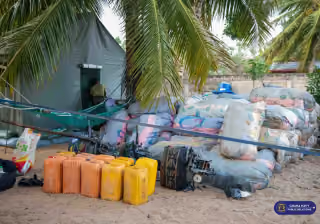
The Narcotics Control Commission destroyed 564.39 kilograms of cannabis at Bundase alongside synthetic opioids and codeine-infused cough mixture. The cannabis was valued at US$112,878, and the Ghana Standards Authority confirmed cannabis in samples before destruction.
The Narcotics Control Commission (NACOC) destroyed seized narcotic drugs at
Bundase in an exercise with an estimated street value of more than US$10
million.[1][2][3][4][5][6][7][8][9][10]The destroyed stock included 564.39 kilograms of cannabis, valued
at US$112,878.[1][2][3][4][5][11][6][8][10][12]The same destruction included 4,730,100 capsules and tablets
of synthetic opioids, estimated at US$5,912,625, and 338,000 bottles of
codeine-infused cough mixture, valued at US$4,225,000.[1][2][4][5]The Ghana Standards
Authority verified the authenticity of the seized substances before destruction,
and tests confirmed cannabis in the samples.[1][13][4][5][6][8]
After the exercise, NACOC Director-General Major General Maxwell Obuba Mantey
spoke to the media.[1]Mantey said the Commission remained committed to
fighting narcotics despite a recent drug seizure in Lebanon linked to Ghana.[1][5][6]He said the Lebanon-linked seizure did not mean the Commission had failed
in its mandate and that it would continue efforts against drug trafficking
despite the challenges.[1][4]Mantey reaffirmed the Commission’s resolve to
intensify efforts to tackle the narcotics trade.[1][4]He said NACOC would not
give up in the face of challenges.[1][8]He said the commission would pursue
traffickers wherever they were and believed it would win the fight.[1][8]
The seized drugs had been cleared for destruction through court orders.[3][11][10]The destruction took place at the Bundase Infantry Training School in the Greater Accra Region on 5 November 2026.[3][11][7][10][12]NACOC put the combined value of the three categories at US$10,250,503.[3][11][12]
Mantey said the Lebanon incident should not be viewed as evidence of institutional failure.[4]NACOC did not disclose exactly where the destroyed substances had been seized.[4]
The drugs destroyed had been confiscated during NACOC’s anti-drug operations.[5]
Mantey urged the public to report suspicious activity to the Commission and said its doors were open to anyone with information on drug trafficking.[6]
Mantey said collaborating institutions gave the exercise transparency and accountability in handling the exhibits.[8]Mantey said some international partners had described Ghana as increasingly becoming a “no-go area” for drug traffickers after recent enforcement successes.[8]Mantey said NACOC held more than 10 million tramadol tablets awaiting court processes for destruction.[8]He said details of some operations were withheld because of the sensitivity and complexity of the investigations.[8]
The Commission said the exercise formed part of its efforts to rid the country of illicit drugs seized in its enforcement operations and to stop them re-entering circulation.[12]
Photos and video
A fire burns the destroyed drugs at Bundase; the image is captioned “cannabis destruction.” No photo credit is listed.Photo details
Original
800 × 458 px · WEBP · 38 KB
SHA-256
4223f77d7404e4e0…
Retrieved
6 Nov 2026
Shown
our 320px copy; enlarging loads the original
Source: 3NewsA second view of the burning drugs at Bundase, captioned “cannabis destruction 2.” No photo credit is listed.Photo details
Original
835 × 463 px · PNG · 863 KB
SHA-256
64cf9651ef1e0dc5…
Retrieved
6 Nov 2026
Shown
our 320px copy; enlarging loads the original
Source: 3NewsNACOC officials destroy seized illicit drugs at Bundase.Photo details
Original
300 × 200 px · JPEG · 70 KB
SHA-256
40566bbf360a1747…
Retrieved
6 Nov 2026
Shown
our copy, at the original's full size
Source: GhanaWebThe page picture carried by Citi Newsroom with the NACOC destruction story; it has no listed caption or photo credit, so it is not established to show the burning at Bundase.Photo details
Original
750 × 375 px · PNG · 461 KB
SHA-256
cbf0d63da4275339…
Retrieved
6 Nov 2026
Shown
our 320px copy; enlarging loads the original
Source: CitinewsroomCaptioned “The illicit drugs being distroyed”, showing the NACOC consignment at the Bundase destruction; no photo credit is given.Photo details
The article gives no separate date for the destruction; 5 November 2026, its publication date, is used as the incident date.
No arrests, charges or court outcomes connected with this destruction were reported.
No second accessible report of this destruction was found.
The two photographs have no listed photographer or photo credit.
Left out, as its quotation was not found in GhanaTalksRadio: The same destruction included 4,730,100 capsules and tablets of synthetic opioids, estimated at US$5,912,625, and 338,000 bottles of codeine-infused cough mixture, valued at US$4,225,000.
No source gives a date for the destruction apart from the 5 November 2026 publication dates, including Yen.com.gh's.
MyJoyOnline gives no date for the destruction; 5 November 2026, its publication date, stands in for the event date.
MyJoyOnline does not say where the destroyed cannabis had been seized or how much the cannabis alone weighed beyond the 564.39 kg figure.
Citinewsroom gives no separate date for the destruction; its 5 November 2026 publication date is the only date the source provides.
The article states the codeine cough mixture and opioid values only as running text, so they are left out of this corroboration.
The Citinewsroom page image has no caption or credit, so it is not established to show the destruction itself.
Modern Ghana, reprinting a Ghana News Agency story, puts the codeine-based cough mixture at 3,308 bottles, while the report records 338,000 bottles from other outlets.
Modern Ghana gives the overall value as approximately US$10.3 million, against the US$10,250,503 total the report records.
Modern Ghana's 564.39 kg figure is described as “cannabis and related products” without a separate cannabis street value or a location where the substances were seized.
The Modern Ghana page photo carries only the headline as its caption and no credit, so it is not established to show this destruction.
The page is dated 5 November 2026 and gives no other date for the destruction.
The TV3 video item gives no location, no cannabis weight and no break-down of the substances destroyed.
No arrests, charges or court outcomes connected with the destruction are reported.
The page photo is captioned only “The illicit drugs being distroyed” and carries no photographer or agency credit.
Ghana Navy personnel with NACOC and National Security found 117 sacks of suspected Indian hemp, about 4.7 tonnes and valued at more than US$1 million, on two abandoned wooden boats at the Ada Estuary on 5 November 2026. The occupants fled before the patrol reached them, no arrests were made, and the sacks were handed to NACOC pending laboratory tests.
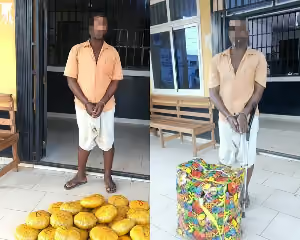
The Tema Regional Police Command arrested 52-year-old Ibrahim Saani at New York, near Airport Junction, on 25 October 2026, retrieving 37 parcels of suspected Indian hemp and a crusher in an intelligence-led operation. Police say he may have been distributing in the area while feigning mental illness to hide his activities.
GRA Customs' Aflao Preventive Monitoring Unit tracked a black Lexus to Torve on the night of 15 October 2026; the driver fled after a mechanical fault and officers found 1,065 compressed parcels weighing 560.4 kg, worth GH¢11.2 million, now with NACOC.
The Upper East Regional Police Command arrested 36-year-old Tumbana Ane at Paga around 5 October 2026, searching his residence to find 38 parcels of dried leaves suspected to be Indian hemp plus Tramadol. Police also found a suspected escape tunnel in the house and linked Ane to alleged brothel operations at an illegal mining site at Wuru, Kayoro.