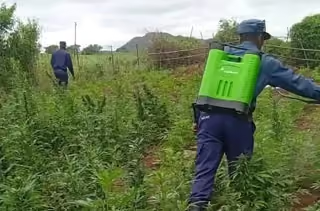
The Royal Swaziland Police Department runs an ongoing operation that destroys marijuana grown for commercial purposes.[1] Marijuana valued at nearly $1 million was burned in a recent police operation.[1] The UN Office on Drugs and Crime said Swazi eradication is expensive because cultivation happens mostly in remote, hard-to-access areas and the law-enforcement agencies do not have sufficient capacity.[1] The UNODC regional spokesperson Andreas Zeidler said the police do regularly seize large amounts of cannabis and arrest suspected traffickers inside the country and at its borders.[1]
For 75-year-old Gogo Thwala, who looks after six grandchildren, selling cannabis that grows around her mud-and-stick house is how she buys food.[1] She said police had come and she told them that, as an old woman, she could not look after her garden.[1] Her cannabis garden, known locally as dagga or insangu, stretches over a half-acre plot between maize plants, trees and boulders, with some plants over 2m high.[1] Larger fields belonging to neighbours are hidden in mountain crevices, making them hard to detect when law enforcers make their rare inspection tours.[1]
Most of the crop is sold on the domestic market and in South Africa, where a small packet sells for US$2 on the streets, while the best quality is compressed into one- or two-kilogram blocks and smuggled through South Africa and Mozambique to Europe.[1] The government is not considering legalising marijuana and has not examined whether cannabis or hemp could become an economically viable crop.[1] A Ministry of Justice source said Swaziland is a signatory to international drug accords and has to discourage trafficking of drugs grown in the country from crossing the border.[1] A South African institute’s review of regional drug strategies found interception, seizure and border interdiction had shown limited or low success rates, with enforcement focused on low-level dealers, consumers and couriers.[1]