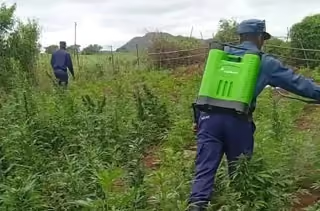
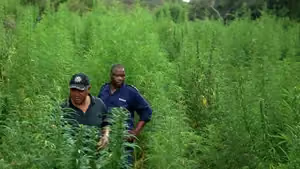
A unit of 30 police officers trekked 5 km through rugged terrain in the northern Hhohho region and reached a clearing planted with cannabis.[1] The clearing held hundreds of cannabis plants over six feet tall, known locally as dagga, with shovels, plastic sheets and watering cans around its edges.[1] No growers were present when the police arrived.[1] The head of Swaziland’s anti-drug unit, Supt Albert Mkhatshwa, accompanied the search-and-destroy operation and said such plantations were nothing out of the ordinary.[1] Police said they would spray the crop with weed killer so the plants would be dead within a day or so.[1]
Swazi anti-drug unit statistics for the first seven months of 2006 recorded 2,407 kg of compressed cannabis seized.[1] The same statistics recorded a further 356.5 hectares of cannabis plantations destroyed.[1] Mkhatshwa said his units now go into dense bush and mountainous areas on foot with weed killer and spray every two weeks, but it is not having much impact.[1] South Africa recently withdrew assistance such as helicopters and off-road vehicles, leaving Swazi police with meagre resources.[1] South African Police spokesperson Ronan Naidoo said cooperation on operations was no longer in place because of escalating costs.[1]
Once compressed and packaged, consignments are taken into neighbouring countries using back roads or holes cut in the border fence, which Mkhatshwa called notoriously difficult to monitor.[1] South Africa’s Institute for Security Studies said the best-quality harvest is compressed into one- or two-kilogram blocks smuggled via South Africa and Mozambique to Europe and the UK.[1] The institute found growers received between $45 and $52 per kilogram, while high-quality Swazi Gold fetched as much as $7,600 per kilogram in the UK.[1] The institute added that high-quality Swazi Gold fetched as much as $7,600 a kilogram in the UK.[1]