8,723 plants seized in two licensed Ohrid-Struga farm raids
Police in North Macedonia raided two licensed medical-cannabis farms near Lake Ohrid in July 2022, seizing 8,723 plants and 343 kg of dry flower over two days. Health-ministry experts put the potential black-market yield at five million euros; both firms lost permits and faced prosecution in Struga.
🇲🇰 Orovnik, Debrca and Drsalajca, Struga, Lake Ohrid region · North Macedonia
In the summer of 2022 police raided two cannabis plantations near Lake Ohrid
within 48 hours.[1]Both plantations held licences to grow cannabis for
medical use.[1]Criminal police with the medical-cannabis commission and Ohrid
police searched a legal entity in Orovnik, Debrca municipality on a court order.[2]Officers then searched a facility in Drsalajca, Struga municipality,
closing its medical-cannabis factory.[3]The action in Drsalajca took place in
a building in that village.[3]The Ohrid farm was operated by Greengo 2018
with three owners while the Struga farm was the property of Green and Bio Farm
with two owners.[1]Permits were revoked after the raids and Struga
prosecutors opened investigations into both firms for regulatory violations and
illegal drug production and trade.[1]
In the Orovnik safe room officers found 343 kg of dry flower, 7 kg more than
recorded.[2]In the attic officers found vessels used for cannabis-oil
production although the firm had no permit for such oil.[2]At Drsalajca the
video did not cover the whole facility and the fence had holes allowing
unimpeded entry and exit.[3]Officers found 3,442 outdoor plants without
protection against 4,304 reported.[3]Officers found another 1,007 plants plus
seedlings in an outer parcel where the firm had only an expansion permit, not a
planting permit.[3]Health-ministry experts said those Drsalajca plants could
have produced about 2.5 tons worth five million euros on the black market.[3]In the Orovnik case a prosecutor was notified and all items were seized.[2]In
the Struga case a prosecutor was notified and all items were seized.[3]
North Macedonia legalised medical cultivation in 2015 with a five-person
health-ministry commission tracking production and inspecting plantations twice
a year.[1]By 2021 more than 60 firms held permits under strict
record-keeping, surveillance and fencing rules, with around half producing.[1]The violations uncovered suggested much of the product was heading to the
illegal market.[1]A settlement was reached in the first case while the second
remained in regular procedure.[1]
Photos and video
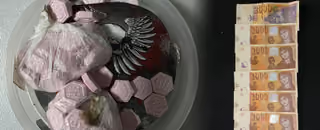
Seized cannabis after a police raid in the region of Struga, North Macedonia. Photo by the Ministry of Interior of North Macedonia.Photo details
Original
1600 × 1000 px · JPEG · 225 KB
SHA-256
f67b2cf36d180397…
Retrieved
6 Nov 2026
Shown
the publisher's file, through an image proxy
Source: Balkan InsightThe contested outdoor plantations near the town of Ohrid in North Macedonia. Photo by the Ministry of Interior of North Macedonia.Photo details
A1ona1on.mkMKВИДЕО: Претрес во правен субјект за одгледување канабис за медицински цели во охридско, пронајдена неевидентирана дрога, се работело спротивно на пропишаните услови
Sitelsitel.com.mkMKЗатворена фабрика за производство на канабис за медицински цели во Струга
Open questions the AI reported
The report uses 15 July 2022, the Drsalajca search date, for a two-day operation that began with the 13 July Orovnik search; Balkan Insight describes the raids only as within 48 hours in summer 2022.
The 8,723-plant total sums 2,388 plus 1,066 seedlings plus 820 plants at Orovnik and 3,442 plus 1,007 plants at Drsalajca; additional uncounted seedlings at Drsalajca were reported without a number.
The 343 kg total covers dry flower found in the Orovnik safe room; 269 kg of shake plus drying branches and ready flower found elsewhere were reported without a clear seized weight and are excluded from cannabis weight.
The 2.5-ton figure and five-million-euro value are health-ministry experts' hypothetical yield if Drsalajca plants had flowered, not a weighed seizure.
Balkan Insight's rounded account of 600 of 1,000 reported plants plus 2,000 outside at Ohrid and about 1,000 outside at Struga differs from the detailed MVR counts used for figures; the detailed counts are retained.
No arrests were reported; six people found at Orovnik were described only as unregistered workers, and no charges or trial outcomes beyond Struga investigations and a settlement in the first case were published.
The MVR releases do not name Greengo 2018 or Green and Bio Farm; company names and ownership come from Balkan Insight only.
Left out, as its quotation was not found in A1on: At Orovnik the surveillance did not work and officers found 2,388 outdoor plants plus 1,066 seedlings against 616 reported, plus 820 indoor plants although the firm had reported no production during renovation.
A 65-year-old woman was arrested at Idrizovo prison near Skopje on 8 November 2026 after marijuana was found in a parcel she brought for her imprisoned son. Police seized the drug during the package inspection and took her into custody, with a criminal complaint to follow.
Police in Veles detained two local men, aged 36 and 26, after marijuana, tablets and a digital scale were found near them, and later searched the older man's home under a court order, seizing money. Both were held at the police station and the prosecutor was informed; no amounts or charges were published.
Police in North Macedonia detained five people in separate drug checks on 31 October and 1 November 2026, including two German nationals stopped at the Tabanovce border crossing with marijuana. The Interior Ministry said marijuana, cocaine and brown powder were found at locations including Skopje, Bogovinje, Ohrid and Idrizovo prison.
Police in North Macedonia detained 13 people aged 18 to 46 in drug operations in Skopje, Prilep, Demir Kapija, Bogovinje and Štip on 30 and 31 October 2026, seizing marijuana, white powder and tablets. The Interior Ministry said charges would follow once the cases were documented; no weights were given.