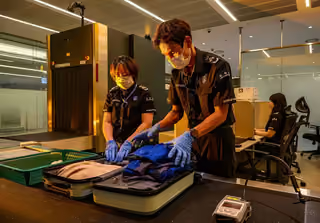
South Korea's customs report 657 kg of drugs seized with Thailand and Cambodia
South Korea's Korea Customs Service said its January-March 2026 joint crackdowns with the Thai and Cambodian customs agencies intercepted 657 kg of narcotics in 32 cases, including marijuana, methamphetamine and etomidate. The agency gave no separate cannabis weight, and no arrests were announced.
🇰🇷 South Korea's border with Thailand and Cambodia (Korea Customs Service, Government Complex Daejeon) · South Korea
South Korea’s Korea Customs Service said its first-quarter joint crackdowns with
the customs agencies of Thailand and Cambodia intercepted 657 kg of narcotics in
32 cases between January and March 2026, a quantity it said could supply about
1.8 million people.[1]Marijuana was among the drugs seized alongside
methamphetamine and etomidate, an anaesthetic used to induce sedation.[1]
Twenty-eight of the cases, holding 651.4 kg of narcotics, came from operation
Trident with Thai customs, the largest haul in a single such operation since the
two agencies began them in 2022.[1]The five Thai joint operations to date
have produced 184 cases and 1,036.9 kg of drugs, according to the customs
agency.[2]The first operation with Cambodia, Lionstone, ran from 26 January
to 28 February 2026 and intercepted 5.7 kg of drugs in four cases, the Korean
customs agency said.[1]The agency said it would pursue the supply chains
behind the intercepted shipments and seek custody of the main suspects through
follow-up enforcement with the two customs agencies.[2]
Customs chief Lee Myeong-ku said his agency would cooperate with other
governments to trace smuggling routes, concealment methods and overseas senders,
vowing that “not a single grain” of drugs would cross South Korea’s border.[2]The agency framed the operations as a way to stop drugs at their overseas
departure points before they reach South Korea.[3]
Photos and video
Korea Customs Service Commissioner Lee Myeong-ku speaks at a press conference at the Government Complex Daejeon on 6 April 2026 presenting the first-quarter drug smuggling results. Photo: Courtesy of KCSPhoto details
The Korea Customs Service did not publish a cannabis-only weight or case count; the 657 kg, 651.4 kg and 5.7 kg totals cover all narcotics, including methamphetamine and etomidate.
No arrests, charges or court action were reported for these cases; the agency said it would seek custody of main suspects in follow-up enforcement.
23 April 2026 is the date the customs results were announced; the joint operations ran from January to 28 February 2026, and the individual seizures are undated.
The Korean and English accounts differ in describing the campaign totals: the English copy says 14 cases and 1,037 kg over the past five operations, while the Korean report says 184 cases and 1,036.9 kg.
The submitted Korea Times page is a reprint of the Yonhap wire story.
The text gives a weight ("657 kg") but the figures have no kg_seized; check whether it belongs there.
Rapper Kim Sang-min, 22, known as Kim Gam-jeon, admitted smoking and possessing cannabis and part of the dealing charges at his first trial in Seoul, while denying he knew a buyer was a minor. The court set the next hearing for 10 December in a case that could bring at least two years in prison.
South Korea's Korea Customs Service reported intercepting 1,007 kg of narcotics in 767 cases bound for the domestic market in the first half of 2026, its largest such haul on record, and said cannabis accounted for 654 kg of it. Traveler smuggling rose 79 percent in cases as traffickers moved off mail routes, and Thailand remained the largest source country.
The food and drug ministry tested 32 overseas-purchase products marketed with cannabis, hemp or kanna and found controlled substances in 22 of them, including cannabis compounds and the temporary narcotic mesembrine. It asked customs to hold the products and platforms to block their sale, and warned that importing or eating them is punishable.
The government set up a joint drug-crime investigation headquarters bringing prosecutors, police, customs and the intelligence service together, after smuggling and online sales rose. In its first 100 days it booked 124 people and detained 56, including a soldier who smuggled 10.2 kg of cannabis from Thailand and a farmer who grew cannabis under a state-funded smart farm.