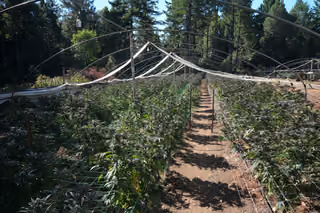
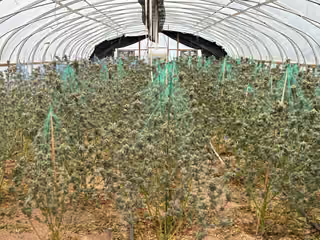
In a Cook County forest preserve about 200 yards from a commuter highway, authorities uncovered an elaborate marijuana-growing operation with six-foot plants nearly ready to harvest and campsites stocked with beer, canned food, insect repellent and a copy of High Times magazine on one cot.[1] On 24 July 2007, with an Illinois National Guard helicopter circling above the Crabtree Nature Center Forest Preserve near Barrington, federal agents joined local police in chopping and burning the crop, which had been found the previous month when a Forest Preserve District intern researching foxes encountered three men and an irrigation system.[1]
Officials called the find one of the nation’s largest illegal cannabis cultivation schemes and the most sophisticated the county had seen: growers had hung coyote urine to deter animals and used a sump pump and generator to siphon pond water to 11 fields hidden in clearings remote from hiking trails.[1] Officers had feared booby traps but found none.[1] The county’s police chief said growers favoured public land because it shielded their homes, vehicles and property from seizure laws.[1]
The federal announcement put the removal at over 38,000 marijuana plants from 14 cultivated fields, with irrigation systems, fertilizer, camping equipment and food at grow sites operated by two Mexican immigrants; three other Cook County preserve sites found earlier in 2007 had yielded another 17,000 plants.[2] After an aerial search on 29 June and surveillance, officers arrested Bernardo Rangel and Jose Verra, both 23, on 10 July while they wore camouflage clothing.[1] Rangel carried a permanent resident card while Verra was in the country illegally, and each was charged with felony cultivation and criminal damage to land plus misdemeanor trespass; Rangel posted $40,000 bail and Verra stayed in county jail.[1]
Early in 2008, Verra and Rangel were each sentenced to two years in prison.[3] They had told investigators they were farmers paid to grow the crop, tending about 20,000 plants, some eight feet tall, valued at $4 million inside the preserve, where officers had also found a tent, food, fertilizer, a cooking and shower area and a reinforced log-and-dirt bunker 30 yards away.[3]