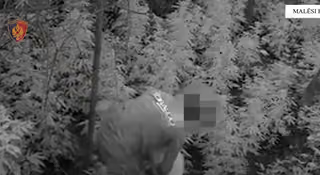
Albanian authorities arrested, detained or prosecuted 165 people in connection with drug cultivation.[1][2] Dhimitraq Ziu reported 593 recorded cultivation cases, 94 of them solved or 15.9 percent, listing 70 people arrested, 51 detained, 13 proceeded against at liberty and 34 declared wanted.[3] Separately, 89 village heads, OSHEE employees and forestry and environmental staff faced criminal proceedings for abuse of office and failure to report crimes.[4] Among those 89 officials, five were arrested, 12 were detained, 68 were proceeded against at liberty and four were declared wanted.[3]
Across those cultivation cases, officers found and destroyed 171,566 narcotic plants in total.[3] Aerial surveillance covered 67% of Albanian territory, identified 1,301 cannabis plantations, and enabled police to uproot and destroy 105,732 plants.[5] Data presented at the annual conference showed about 32,000 fewer destroyed plants than in the previous year.[3] Police also identified 132,000 cannabis seedlings before cultivation, compared with 17,447 a year earlier.[1][2] State Police Director General Skënder Hita said preventive operations seized seeds intended for cultivation and destroyed seedlings in pots or newly planted in the ground.[4] Officers also disrupted 17 cases of indoor cannabis cultivation using grow lamps.[4][2]
Hita presented the 2026 anti-cultivation and school-perimeter efforts during a joint conference with Italy’s Guardia di Finanza.[1][5] The activities were funded by the Department and coordinated by the Central Directorate of Criminal Police through the Service for International Police Cooperation (SCIP), with the Guardia di Finanza General Command and scientific input from the Benecon Consortium.[5] The results came from the fifteenth edition of the aerial surveillance campaign.[5] Interior Minister Ervin Demo, Italian Ambassador Marco Alberti and senior Italian police and Guardia di Finanza officials joined the conference in Tirana.[6][5] The presentation was also attended by public-order director Dhimitraq Ziu for Albania and by SCIP Director Lorenzo Bucossi and Guardia di Finanza Brigadier General Giancarlo Franzese for Italy.[5] Police deployed 84 drones to monitor territory, flew 62 aerial missions with Guardia di Finanza, 10 more than in 2025, and inspected remote mountain areas with military helicopters seven times.[1] Shkodër County accounted for the largest share of destroyed plants, followed by mountain areas of Krujë, Mirditë and Tropojë.[3] Guardia di Finanza commander Giancarlo Franzese said growers had shifted toward planting cannabis in smaller, less detectable plots.[3] Joint controls also prevented any reported cannabis smuggling attempt across the Adriatic Sea from succeeding during the season.[3]
In parallel, police finalised 31 operations against dozens of drug-sale incidents near school security perimeters in 2026.[4] Hita noted that the school-perimeter effort covered narcotics including hard drugs alongside cannabis.[4] Hita stressed that effective school prevention required cooperation among police, the Education Ministry, school leaders, security officers, teachers and parents.[1] For 2027, police said they will strengthen inspections and investigations to identify drug-seed import networks and target those organising and financing illegal cultivation.[1]