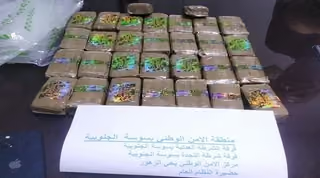
Tunisia's National Guard burns 538 kg of cannabis at a cement plant
Tunisia's National Guard destroyed 538 kg of seized cannabis on Wednesday 18 February 2026, burning it at a cement plant under public prosecutor supervision. The cannabis came from a two-month intelligence operation that led to several arrests, with other suspects still said to be abroad.
Tunisia’s National Guard burned a large quantity of seizednarcotics on
Wednesday 18 February 2026, in what it presented as part of national efforts to
fight drug trafficking and cut off its supply routes.[1]The burning took
place at a cement plant, under the supervision of the public prosecutor and in
the presence of the other authorities concerned, to ensure the legal procedures
in force were followed.[1]
National Guard spokesman Colonel-Major Houssem Eddine Jebabli told Mosaïque FM
that the operation destroyed 538 kg of cannabis.[1]The 538 kg came from a
National Guard operation that the report calls qualitative, run by the guard’s
intelligence and investigations directorate with its intelligence
sub-directorate and the central anti-narcotics brigade.[1]The operation
followed nearly two months of intelligence work and led to the arrest of several
people implicated, while other suspects remained on the run abroad.[1]The
National Guard’s general directorate said it oversaw the destruction of a
significant quantity of seized narcotics on Wednesday 18 February 2026 as part
of ongoing national efforts to cut off drug-trafficking supply sources.[2]
Jebabli said the presence of the media at the burning was meant to build trust
in the security institution and clear up any doubt about what happens to seized
goods.[1]Jebabli said drug enforcement could not be limited to a repressive
approach and called for coordination between state institutions, civil society
and the media.[1]
Photos and video
Cannabis, the only caption given to the page picture of the National Guard destruction on 18 February 2026; the photo carries no credit.Photo details
No place is named for the cement plant or for the governorate covered by the intelligence operation, so Tunisia as a whole is used as the place.
The number of people arrested is not given and no suspect is named; other suspects were said to be abroad.
No charges, prosecutor's decisions or court proceedings against the arrested suspects were reported.
The reports do not say whether the 538 kg was cannabis resin or herb, and no value was published for it.
Only a French-language account and an English translation of the same National Guard statement were found; Mosaïque FM's original interview could not be opened.
The article's single picture is captioned only Cannabis and is not shown to be a photograph of this burning.
Tunisia's customs administration said customs guard units seized more than 153 kg of cannabis at border crossings and inside the country in the first nine months of 2026, alongside more than 101 kg of cocaine and 18.6 million narcotic tablets. Spokesman Colonel Chokri Jabri said customs opened more than 11,000 cases in the period involving goods worth over 190 million dinars.
Security units in Sousse Sud, Tunisia, seized 30 slabs of cannabis resin, known as zatla, on the evening of 31 October 2026 and seized a car. Radio Marina reported that a suspect was arrested and detained on the public prosecutor's authorisation, while the search for other members of the network continued.
Tunisia's National Guard seized 110 slabs of cannabis resin, known as zatla, and 338 pieces of cannabis across the country during September 2026. Its general directorate said in a video that the month's anti-drug operations also led to the detention of 1,515 people.
The interior ministry reported on 7 March 2026 that 2025 brought 181,998 judicial cases in total, 14,300 of them drug-trafficking cases, and 69,164 arrests, 20,289 for drug trafficking. It also reported seizures of cannabis, 479,830 tablets, 146.77 kg of cocaine and 751.25 g of heroin. The figures cover police and national guard, not customs.