Record 17 tonnes of cannabis resin seized in Niamey warehouses
Niger's anti-drug police seized a record 17 tonnes of cannabis resin from warehouses in Niamey on 2 March 2021. The resin had come from Lebanon via the Togolese port of Lomé and was bound for Libya; thirteen suspects were arrested in Niamey and Agadez.
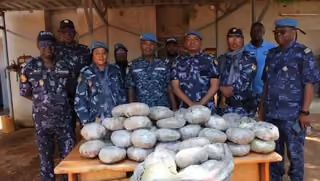
Nigerien police seized a record 17 metric tons of cannabis resin from warehouses in the capital Niamey on 2 March 2021.[1][2][3][4][5][6][7][8]The national anti-drug trafficking agency valued the haul at about $37 million and called it the largest cannabis seizure in Niger’s history.[1][2][4]
The resin had originated in Lebanon, the first drug shipment known to have come from there, according to agency spokesman Adili Toro.[2][3]It had passed through the Togolese port of Lomé before being trucked north more than 1,000 kilometres and across two border crossings to Niamey.[2][3][6]The traffickers had planned to move it onward in trucks to Libya via the desert town of Agadez, a hub for smuggling goods and migrants across the Sahara.[2][3][5][6][7]
Police arrested eleven Nigeriens and two Algerians in Niamey and Agadez.[2][3][5][6][7][8]Interpol, which confirmed the bust in May, said the seizure came out of March and April enforcement operations run with customs and police from 41 countries, during which traffickers were moving larger loads to work around COVID-19 travel restrictions.[1][4]
A later analysis reported claims from its contacts that part of the shipment was reacquired by trafficking networks after the seizure, which the anti-drug office denied, saying the resin was incinerated on 24 April 2021 in the presence of the interior and justice ministers.[9]
The drugs left Beirut in a container carried by an Indian company to the port of Lomé, where they were loaded onto a Beninese-registered truck bound for Niamey.[3][5][7]The drugs were packed in fruit cartons and were to be repackaged in a purpose-built and equipped warehouse in Niamey’s Plateau quarter.[3]
The resin was brought to Niamey concealed in a Beninese-registered tanker presented as carrying hydrocarbons.[6][8]The resin was packed in watertight packaging, with each of thousands of small packets bearing a specific recipient’s name.[6][8]
Interior Minister Alkache Alhada told a press presentation that nearly 20 billion CFA francs of resin had been seized in a Niamey warehouse.[7]The drugs are valued at 20 billion CFA francs, which the article put at more than 34 million euros.[7][8]The material was seized on 2 March in a district on the outskirts of Niamey.[7][8]
The shipment travelled from Lebanon to the Togolese port of Lomé through an Indian company.[8]
Photos and video
Press photograph accompanying the report on the 17-tonne cannabis resin seizure in Niamey. Photo: Nicolas TucatPhoto details
The identities of the thirteen people arrested and any court outcomes were not reported in the opened sources.
A later analysis reported contacts saying part of the haul leaked back to traffickers, which the anti-drug office denied, saying the resin was incinerated on 24 April 2021; the opened sources do not resolve this dispute.
This source gives no separate incident date beyond its 17 May 2021 publication date and a March-April operation window, so the 2 March 2021 date stays from earlier sources.
The same article also reports a separate South African cocaine seizure of 973 bricks with 10 arrests and a combined 287 arrests across March-April operations, which are not cannabis figures for this report and are left out here.
This account states the arrests without naming an Agadez arrest location and gives no identities or court outcomes beyond committal to custody.
This account specifies concealment in a Beninese-registered tanker supposedly carrying hydrocarbons and watertight packages bearing recipient names, details not in the existing sentences.
A report added on 8 November 2026 is the same AFP dispatch already carried by lematin.ch; it is not independent reporting.
The only image on this page is captioned as an illustration, so it is not evidence of this seizure.
The VOA Afrique page is the AFP dispatch also carried by lematin.ch and 20 minutes, so it is not independent reporting of the seizure.
This account attributes the first-from-Lebanon statement to Interior Minister Alkache Alhada at a press presentation, while existing sentences attribute it to agency spokesman Adili Toro.
This account says the thirteen suspects were arrested and committed to custody (écrouées) but does not say where each was held and gives no identities or court outcomes.
This account names an Indian company as the shipping intermediary for the Lebanon-to-Lomé leg, a detail not in the existing sentences.
Niamey Customs Brigade officers intercepted 154 balls of cannabis about 22 km south of the Kouré checkpoint on 9 September 2026, a haul Customs called a brigade record. Acting on prior intelligence, officers stopped the suspect cargo before it continued; no arrests were reported.
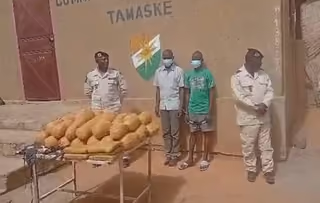
Police in Tamaské, Tahoua region, seized 45 kg of cannabis and arrested two suspects on 22 April 2026. Local and departmental authorities praised the operation as a blow to trafficking networks and urged residents to report suspicious activity.
Niger's OCRTIS anti-narcotics office dismantled a transnational cannabis network on 31 March 2026 when a routine check of an Algerian-registered truck bound for Tamanrasset found 154 bricks and 28 balls of cannabis hidden in a chassis compartment and spare tyres. Ten people aged 16 to 42 were detained; the load was valued at more than 30 million CFA francs.
Niger's anti-drug office, OCRTIS, arrested two suspected members of a cross-border cannabis network in Konni, Tahoua Region, one of them a Nigerian courier stopped at Saléoua. The case began with 44.225 kg of cannabis resin found in Konni on 30 October and ended with some 57 kg of cannabis seized in all, alongside tens of thousands of psychotropic pills.