Six get life in Lebanon's Dr Food hashish-biscuit case
Mount Lebanon's criminal court sentenced TikToker Georges 'Dr Food' Dib and five co-defendants, including three Syrians, to life with hard labour for making hashish bars and hiding them in biscuit packs for export via Turkey. The case followed a 2024 seizure of 820 kg of hashish, and each convict was also fined 120 million Lebanese pounds.
The Mount Lebanon Criminal Court sentenced Georges Hanna Dib, known as Dr Food,
and several co-defendants to life at hard labor in absentia in a drug case.[1]The six are Dib, Syrians Kamal Abbas Ramadan, Abdel Karim Zaher al-Salem and
Ahmad Dolf al-Youssef, and Lebanese Hassan Atiyeh Diab and Mohammad Abdullah
al-Ali.[2]Ramadan and al-Salem were tried in custody, while Dib and
al-Youssef were sentenced in their absence.[2]Each convict was fined 120
million Lebanese pounds and those convicted in absence were stripped of civil
rights under Article 150 of Lebanon’s drug law.[2]
The group manufactured narcotics from the hashish plant and hid them inside
company products for shipment from Lebanon abroad via Turkey.[2]Hashish
hidden in cake packaging produced in Baalbek in eastern Lebanon was transported
to Turkiye and then shipped internationally.[3]The sentencing followed a 2024
bust involving 820kg of hashish hidden in cake packaging.[3]Dib allegedly had
the packaging produced at a facility in the Charawneh neighborhood of Baalbeck
in the Bekaa Valley.[1]
The ruling was issued by a court presided over by Judge Elie al-Helou.[1]Dib,
a widely followed food influencer, was believed to be outside Lebanon and had
not addressed the ruling on his public pages.[3]
Case data
Every number and detail the sources state, with the sources that state it.
The article gives no separate sentencing date; 16 July 2026 is the publication and circulation date, while another outlet says the ruling was issued in March and circulated in July.
The custody status of the two Lebanese convicts at trial was not clearly stated, with one account listing them without qualification and another describing the ruling as in absentia.
The indictment named ten other suspects plus the company, but the sentence reports name only six convicts, leaving the outcome for the remaining suspects unclear.
No cannabis-only valuation was published; the 120 million Lebanese pound figure is a court fine, not a drug value.
Background reporting mentions a 2023 airport seizure of about 1.266 kg in the same investigation, which is not counted separately to avoid double-counting with the 820 kg 2024 seizure recorded here.
The precise seizure site for the 820 kg reported in 2024 was not specified beyond the 2024 bust, while manufacturing and storage were linked to Baalbek and the Beirut airport road.
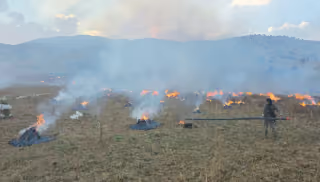
Lebanese forces eradicated 255 dunams of cannabis across Baalbek-Hermel from January to 10 November 2026, ending with an operation in Jerd Marjhine. The crop remains unlawful because parliament's 2020 medical-cannabis law still lacks implementing decrees.
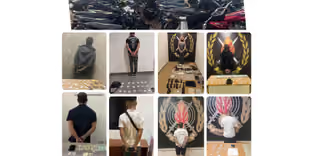
Lebanon's Internal Security Forces arrested eight people from several drug-dealing networks in ambushes and raids on different dates in Bourj al-Barajneh, Nabaa, Zouk, Ouzai, Tyre, Tripoli, Dekwaneh and Sabtiyeh. Officers seized hashish, marijuana and other drugs along with 18 motorcycles and several firearms, but published no weights for any of the drugs.
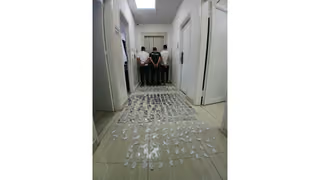
Lebanon's Internal Security Forces raided an apartment on Mariam Street in Aramoun, near Al-Mustafa Mosque, and arrested three Syrian men they accuse of dealing drugs. A search found hashish in a large black bag and 11 smaller bags, plus Captagon pills, sachets of other narcotics, a handgun and a motorcycle.
Lebanese army units detained 28 people in raids and checkpoints across several regions. At the al-Sufri checkpoint in Baalbek, soldiers arrested a man for shooting and seized a quantity of hashish from him.