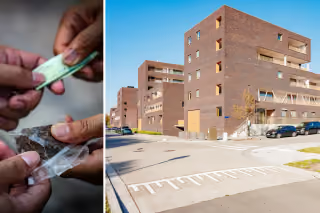
Four people went on trial in Mechelen before the correctionele rechtbank, the criminal court, over the sale of cannabis and hashish.[1] Cannabis was dealt first from a home in the Mahatma Gandhiwijk and later from a building in the Korte Schipstraat.[1] Prosecutor Karel Berteloot said the investigation began early in 2026 after police received information about possible drug sales from a home in the Korte Schipstraat.[1] During surveillance officers witnessed what may have been five drug transactions and intercepted two people, and investigators found that drugs could be ordered through a Snapchat account.[1]
A house search turned up 400 grams of cannabis, drug paraphernalia, cash and phones.[1] The two people present, B.E., 24, and A.C., 19, were arrested and questioned.[1] A.C. told the investigating judge she had been a couple with B.E. for about four weeks and had helped with sales from her home for about two weeks, with the money going to her boyfriend, Berteloot said.[1] B.E., who has an address in Maarkedal, denied any involvement and shifted the blame onto his girlfriend.[1]
Further police work showed that B.E. worked with a Dutch upper dealer and led investigators to an address in the Mahatma Gandhiwijk, where N.G. lived.[1] During a search there the occupant pointed to a room B.E. regularly used, where police found nearly five kilograms of cannabis and nearly two kilograms of hashish.[1] N.G. said he had become a customer of B.E. and offered his home as storage in exchange for free cannabis, but claimed no part in the actual trade.[1] B.E. received his supply from the upper dealer through a courier; on one occasion N.G. accepted the package and handed nearly 17,000 euros to the courier.[1] Police later stopped the car used to carry drugs to the Gandhiwijk, and the driver, D.A., admitted collecting money from N.G. and delivering a box, while saying he did not know its contents.[1]
Prosecutors asked for three years in prison and a 2,000-euro fine for B.E., along with confiscation of 40,000 euros and a car, and for ten-month suspended terms for A.C. and N.G. and an 18-month suspended term for D.A.[1] A.C.’s lawyer said her client was a vulnerable, easily influenced 19-year-old whose role was limited and asked for a suspension of sentence.[1] A.C. refused to stand when the judge asked her to confirm her identity.[1] The other three defendants are due to speak next week.[1]