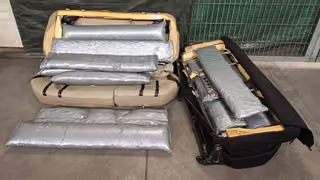
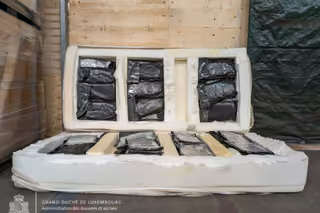
Luxembourg’s public prosecutor’s office reported on Friday 9 January 2026 that authorities seized nearly 3.5 tonnes of drugs at Luxembourg Airport’s cargo centre in 2025, a sharp increase from previous years.[1]
The prosecutor’s figures put the 2025 haul at 2,254.701 kg of cannabis and 107.937 kg of hashish, alongside 873.709 kg of cocaine and 73.938 kg of methamphetamine.[2] Cannabis and hashish together made up 2.3 tonnes of the haul, the bulk of the drugs seized by weight in 2025.[1] More than 2,254 kg of cannabis was intercepted over the year, compared with 227 kg in 2022, alongside 107.937 kg of hashish.[1] It was the first time the prosecutor’s office released detailed annual data on drugs intercepted in transit through the country.[1]
Cocaine accounted for just under 874 kg of the total, against one kilogram in 2020 and 3.6 kg in 2021.[1] The prosecutor’s office said the more than two tonnes of cannabis intercepted in a single year showed the scale of the phenomenon and the growing pressure on criminal networks on European transit routes.[3]
L’essentiel reported that the prosecutor’s statement gave no comparison with previous years even as it described a significant rise in seizures at the Cargo Center.[3] About 150 kg of chemical precursors was also seized, a marked decline from previous years, when quantities of up to one tonne were reported.[1] RTL Infos reported that there were 2,025 more drug seizures at the Findel cargo centre in 2025 than in 2024, with more than 800 kilos of cocaine and more than 2.2 tonnes of cannabis.[4]
The prosecutor’s office said geopolitical developments, changes of political regimes in some regions, legislative changes in Asia and America and stronger controls and international cooperation had profoundly altered the production, distribution and supply chains of narcotics.[1] It said networks were shifting away from large seaports such as Antwerp and Rotterdam to alternative transit hubs, including Findel’s air cargo facilities, because of Luxembourg’s central European location, its freight role and its global connectivity.[1] Most of the drugs intercepted at Findel were destined for onward distribution elsewhere in Europe rather than the Luxembourg market, although a small share may reach it.[1]
Customs officials now systematically analyse shipping documents and carry out targeted checks and full inspections where suspicions arise, while the criminal police’s organised crime and narcotics units developed specialised detection methods and training.[1] Seized substances are analysed toxicologically and forensically and then destroyed under strict security conditions, while authorities warned that similar volumes in other countries have led criminal groups to try to recover seized narcotics or carry out violent attacks.[1]