Afghan special forces destroy 34 tons of hashish in Logar
A combined Afghan Special Mission Wing and National Interdiction Unit raid on a Taliban drug cache in Mohammed Agha district, Logar, seized 34 tons of raw hashish and 300 kg of processed hashish on 12 December 2017. NATO said the hashish, destroyed on site with air force munitions, took $5.6 million in potential revenue from the Taliban.
🇦🇫 Mohammed Agha district, Logar province, Afghanistan
A combined operation by the Afghan Special Mission Wing and the National
Interdiction Unit hit a Taliban drug cache site in Mohammed Agha district, Logar
province, on 12 December 2017.[1]The force seized34 tons of raw hashish and
300 kg of processed hashish, a combined 34.3 tonnes.[1]NATO said removing the
hashish took $5.6 million in potential revenue from the Taliban’s trafficking
enterprise.[1]
The hashish was destroyed at the site by the NIU and Afghan Air Force A-29
aircraft.[1]NATO described the haul as one of the largest narcotics seizures
the Special Mission Wing, a special aviation wing supporting Afghan special
forces on counter-narcotics missions, had supported.[1]
CounterVortex noted that NATO described the material as raw hashish, which it
took to mean herbaceous cannabis, alongside processed hashish.[2]
CounterVortex reported that the Special Mission Wing provided air support to
Afghan counter-narcotics police in the raid on the Taliban cache.[2]
General John Nicholson, then commander of NATO’s Resolute Support mission, said
at a November 2017 Pentagon briefing that the Taliban had evolved into a
criminal or narco-insurgency fighting to defend its revenue streams.[1]From 1
June to 30 November 2017 the NIU and Afghan army commandos seized and destroyed
narcotics, equipment and precursors worth more than $76 million, a campaign
total separate from this raid.[1]
Photos and video
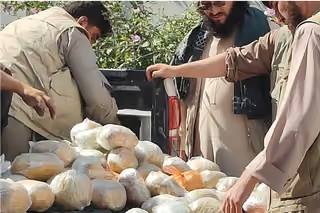
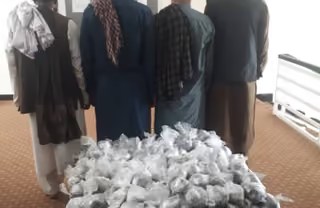
Courtesy photo from the National Interdiction Unit of the operation that seized and destroyed 34 tons of raw hashish and 300 kg of processed hashish in Mohammed Agha district, Logar, on 12 December 2017. Photo: Afghan National Interdiction Unit courtesy photo, published by DVIDSPhoto details
NATO called the material hashish and did not say whether the 34 tons of raw hashish was plant material or unprocessed resin, so the combined 34.3 tonnes is recorded as hashish weight under the sources' own description.
Neither source reports any arrests, detainees or casualties from the raid.
The DVIDS page shows the story date as 18 December 2017 and the seizure as 12 December 2017; the attached photos are dated 12 December 2017.
No local Afghan-language or independent account of the raid was found in the searches, so the quantities rest on NATO's statement and one dependent commentary that quotes it.
CounterVortex's article also describes other, separate seizures and arrests in Helmand and four provinces; those events are not part of this report.
Counter-narcotics police in Afghanistan's Takhar province stopped a car in Taluqan, the provincial capital, and arrested four suspected traffickers. Police said 40 kilograms of hashish and 143 kilograms of opium were hidden in compartments in the vehicle, and the provincial police spokesman put the narcotics seized at more than 180 kilograms.
Police in Pasaband district, Ghor detained 27 people and destroyed eight drug factories during a 20-day operation, seizing 8.5 kg of processed hashish among other drugs and vehicles. The detainees were referred to court and all seized narcotics were destroyed by burning.
Khost anti-narcotics officers seized about 3.2 kg of hashish and more than 3,215 narcotic pills in Speri district, arresting one person. The hashish is the cannabis component of the mixed seizure; the pills and a further 1.4 kg were reported without a clear cannabis link.
Anti-narcotics police stopped a shipment of 245 kilograms of hashish in the Kotol Anjuman area of Paryan district, Panjshir province, and arrested four people. The suspects were referred to judicial authorities after initial questioning. The ministry did not say where the shipment was going.