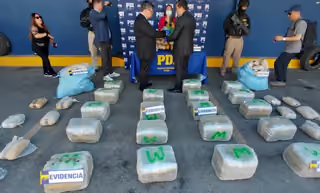
Detectives of the PDI’s Brigada Antinarcóticos y Contra el Crimen Organizado (Briant) in Iquique, working with the Supraterritorial Prosecutor’s Office, dismantled an organisation that brought large consignments of drugs into northern Chile to sell in the south of the Santiago Metropolitan Region and in southern Chile while hiding the origin of its earnings.[1] Officers detained 12 people: six Colombians, five Chileans and one Ecuadorian.[2] PDI director general Eduardo Cerna said the investigation had run for at least six months.[3] Vilas Radio reported that detectives raided premises in La Pintana, Lo Espejo, Paine and Rancagua and arrested the 12 there.[4]
Subprefect René Camilo, head of the Iquique anti-narcotics brigade, put the haul at 2,711 kilos 600 grams divided between cannabis sativa and cocaine hydrochloride.[1] Four of the firearms came from abroad, one of them from the police of Tucumán, Argentina.[1] Cooperativa reported the seizure of eight firearms, one of them identified as stolen from the police of Tucumán in Argentina.[2] Emol reported high-value vehicles and cash taken and commercial activity set up through front men to conceal the profits of bringing in, distributing and selling the drugs.[3] T13 reported that the seized substances were valued at 14,500 million pesos in total, cannabis and cocaine together.[5]
Subprefect Camilo said two Colombian brothers led the organisation and that eight bank accounts used to move its money were frozen, one of them linked to the leader of Los Monarcas de Cali.[1] T13 named the brothers as Ferney and Jefferson Camacho Suárez, who had entered Chile regularly more than three years earlier and installed two barbershops in the Pablo de Rokha neighbourhood of La Pintana as a commercial front.[5] T13 reported that money transfers went to William Ramírez, former leader of Los Monarcas de Cali, who was arrested in Colombia in 2025 on an Interpol red notice and is being extradited to Chile.[5]
Prosecutor Marcelo Vargas Leiva said the 12 accused would be brought before a court on Wednesday 28 October and formalised under the drugs law (Ley 20.000) and the arms law.[1] Vilas Radio reported the detainees would face charges of criminal association, drug trafficking and illegal possession of firearms and military-controlled items before Santiago’s 15th Guarantee Court.[4] El Dínamo reported that the Supraterritorial Prosecutor’s Office and the PDI led the operation, named Operación Cafeteros, which the authorities described as the year’s largest illicit-substance seizure in Chile.[6] La Tercera reported the formalisation would cover people involved across the whole structure of the organisation, not only those who transported the drugs.[7]
Security minister Martín Arrau called the operation good news against drug trafficking while saying border control and investigation remained pending tasks.[1]