1,300 hectares of illegal cannabis destroyed in Kullu between September and October
Police in Himachal Pradesh's Kullu district said a drive from 9 September to 24 October 2026 destroyed illegal cannabis cultivation across nearly 1,300 hectares, with 13 FIRs registered at six police stations. Six agencies took part, from the Narcotics Control Bureau to the Indo-Tibetan Border Police, and police said the campaign would continue.
Police in Kullu district, Himachal Pradesh, registered 13 first information
reports (FIRs), the initial record of a criminal case, against people involved
in illegal cannabis cultivation in September and October 2026.[1]Five cases
were filed at Manikaran police station, two each at Patlikuhal, Sainj and Sadar
Kullu, and one each at Bhuntar and Brau.[1]
The joint drive ran from 9 September to 24 October 2026, police said, and
destroyed illegal cannabis cultivation across nearly 1,300 hectares of the
district.[2]Teams worked in forest beats and villages under Patlikuhal police
station, including Naggar, Fozal, Halan, Neri, Khakhnal, Soyal, Jana, Rumshu and
Sajla.[2]Under Manikaran police station they covered the Kasol forest range
and the Parvati Valley around Grahan, Malana, Tosh, Kutla, Barshaini, Rasol,
Pulga and Manikaran.[2]
The campaign was carried out jointly by the Narcotics Control Bureau (NCB), the
Central Bureau of Narcotics (CBN), the forest department, district police, the
special task force (STF) and the Indo-Tibetan Border Police (ITBP).[2]Police
said the aim was to eliminate illegal cultivation and cut the sources of illicit
drug production and supply.[2]They said the campaign would continue.[2]
Malana, in the Parvati Valley, is known for producing high-quality charas, a
cannabis resin.[2]The district administration appealed to residents to
support a drug-free Kullu campaign.[1]
Photos and video
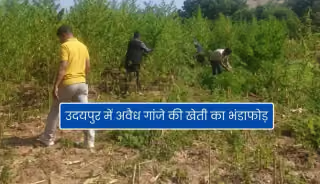
Officials destroying illegal cannabis cultivation in Kullu. Photo: Hindustan Times (HT Photo)Photo details
Neither account reported any arrest, charge or court appearance; the 13 FIRs are cases and no number of accused people was given.
The destroyed area is given only as nearly 1,300 hectares, with no breakdown by police station and no count of plants or weight of cannabis.
An earlier report on the same drive, dated 12 October, gives 592 acres (about 240 hectares) for the Parvati Valley; the sources do not say whether the 1,300-hectare total includes that area.
The Hindi article carries the same police statement as the English report, so the figures rest on one official account rather than two independent counts.
Police in Udaipur district uprooted and seized 779.79 kg of green ganja plants grown illegally in the hills at Khara Kupiya, Mandwa. Three NDPS cases were registered at Mandwa police station against three residents and investigation began.
Police destroyed 467 cannabis plants growing in a villager's house compound at Binayipur in Nabarangpur district, Odisha, and arrested him. The Nabarangpur police registered a case under the NDPS Act, and a sub-divisional police officer gave the account of the raid to reporters.
Sepahijala superintendent of police Bijoy Debbarma said joint police, Tripura State Rifles and BSF teams destroyed at least 1.5 crore ganja plants in Sonamura subdivision over the past year, causing an estimated Rs 1,000 crore loss to the illegal trade. He said the crackdown lay behind a 2 November attack on a BSF team at Ashabari, after which police have arrested 21 people.
Koraput district police and excise teams destroyed 30,000 cannabis plants in joint raids, 12,000 of them at Atal Guda in the Boipariguda block and 18,000 in the Nandapur block, the district superintendent of police said. Koraput police said the Nandapur destruction covered about nine acres of hilly land near Kasandi and Dabuguda.