Two Tigrayan men on Saudi death row for hashish speak from Khamis Mushait
EL PAÍS interviewed two Ethiopian men from Tigray, held under pseudonyms, who are under death sentences for transporting hashish at the Khamis Mushait detention centre in Asir. They described minutes-long trials without lawyers or interpreters, and rights groups warned that dozens of other Ethiopians faced imminent execution.
🇸🇦 Khamis Mushait detention centre, Asir region, Saudi Arabia
Two Ethiopian men from Tigray, identified by the pseudonyms Dawit Tesfay and
Adam Berhe, are being held on death row at the Khamis Mushait detention centre
in Saudi Arabia’s Asir region after being sentenced to death for transporting
hashish.[1]Dawit Tesfay, 24, said he was sentenced after a trial lasting
about two minutes in which he had no lawyer and no interpreter, and that he was
made to sign documents in Arabic he could not read.[1]Adam Berhe, 34, said he
knew he was carrying hashish and agreed because he was destitute in Yemen, and
that he has been awaiting execution for three years.[1]Tesfay said he had
never heard the word hashish until his arrest, having been recruited as a
herdsman shortly after arriving in the kingdom.[1]
Tesfay said his wing of the prison held 68 death row prisoners when he arrived
and holds 55 now.[1]Berhe said eight prisoners were beheaded in the same
prison the week before the interview.[1]Human Rights Watch documented the
executions of at least 20 Ethiopians for drug trafficking between January and
August 2026, the last three on 31 July, and said at least 76 more faced imminent
execution.[1]Amnesty International recorded 96 executions in Saudi Arabia
between 1 January and 22 June 2026, 61 of them for drug offences and 39 of those
of foreign nationals.[1]Amnesty researcher Dana Ahmed said at least 36
Ethiopians were executed in 2025 and 20 in 2026, all for smuggling hashish.[1]
Human Rights Watch researcher Joey Shea said documented cases showed hearings of
a few minutes, some held by videoconference, with no legal representation, and
that appeals had to be written in Arabic by prisoners who could not verify they
were sent.[1]Shea said many of the men fled the 2020-2022 war in Tigray,
crossed the Gulf of Aden to Yemen and were recruited there by trafficking
networks that did not tell them what they would carry.[1]Tigray’s former
youth affairs bureau head and the men’s families asked for legal counsel, fair
trials, repatriation and release, and the African Commission on Human and
Peoples’ Rights urged a review of the sentences.[1]The UN Working Group on
Arbitrary Detention called death sentences for drug crimes in Saudi Arabia
incompatible with international law and urged the kingdom to restore its
moratorium.[1]
Ethiopia’s foreign ministry said in a 13 July release that 1,971 Ethiopians had
received royal pardons and that their repatriation had begun.[1]
Photos and video
Satellite image of Saudi Arabia's Khamis Mushait prison taken in February 2026, where the two men interviewed by EL PAÍS are held on death row. Image: Airbus via Google EarthPhoto details
Original
1200 × 820 px · JPEG · 182 KB
SHA-256
b8ed261deebf08bc…
Retrieved
8 Nov 2026
Shown
the publisher's file, through an image proxy
Source: EL PAÍS EnglishEthiopian migrants on the outskirts of Sana'a, Yemen, in 2023, on the route the men describe taking towards the Saudi border. Photo: Mohammed Hamoud (Getty Images)Photo details
Every number and detail the sources state, with the sources that state it.
Sentenced
2
Agency
Saudi interior ministry
Agency type
Court, Police, Prosecutor
Cannabis
Hashish
Activity
Smuggling, Trafficking
Setting
Land border, Prison
Case stage
On appeal
Sentence
Death sentence
Region
Asir region
Date
Publication date
Sources
EL PAÍS Englishenglish.elpais.com‘I don’t know if I will still be alive tomorrow’: Dozens of Ethiopians ask the world for help from Saudi Arabia’s death row
Open questions the AI reported
The article gives no dates for the two men's arrests, trials or sentencing; 8 November 2026 is its publication date and stands in for the incident date.
Dawit Tesfay and Adam Berhe are pseudonyms chosen for security reasons, so the sentences cannot be linked to named court or interior ministry announcements.
No quantity of hashish, place of arrest or court name was reported for either man.
The claim that eight prisoners were beheaded in the week before the interview comes from one inmate's account and was not corroborated by the Saudi authorities or the rights groups quoted.
Berhe's and Tesfay's account of a two-minute trial and of signing Arabic documents is their own testimony, documented by rights groups in other cases rather than confirmed in these two.
The execution and prisoner totals (Amnesty's 96, Human Rights Watch's 20 and 76, Tesfay's 68 and 55, the 36 and 20 by nationality) are figures for the country's death row, not for these two men.
Only one accessible account of this event was found; searches did not surface another outlet or an Arabic original of the interview.
The satellite image of the prison, credited to Airbus via Google Earth, shows the building, not the men or the conditions inside it.
Left out, as its quotation was not found in EL PAÍS English: Saudi Arabia resumed executions for drug offences in 2022 after a de facto moratorium and executed at least 356 people in 2025, the highest number in a single year since records began, after 345 in 2024, according to Human Rights Watch.
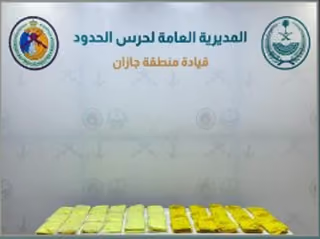
Saudi Border Guard land patrols in the Al-Ardah sector of Jazan region foiled an attempt to smuggle 46 kilograms of hashish, the directorate announced on 11 November 2026. It said initial legal procedures had been completed and the seized drugs handed over to the competent authority, without naming any suspect or giving an arrest figure.
Saudi Arabia's Interior Ministry executed two Ethiopian nationals in the Asir region on 11 November 2026 after convicting them of smuggling amphetamine pills and hashish into the kingdom. The ministry named the men and said their death sentences became final after appeal and confirmation by the Supreme Court.
Saudi narcotics police arrested a Saudi citizen and a Yemeni border violator in Asir region for allegedly promoting hashish, methamphetamine and regulated tablets. Both were referred to the Public Prosecution after initial legal procedures.
Saudi anti-narcotics officers arrested two Saudi citizens in Riyadh for dealing drugs. They seized 10 kg of hashish along with cocaine and 2,170 regulated tablets, and referred the men to the Public Prosecution.