Police and army destroy cannabis on 3 bighas in Jumla
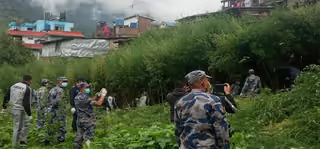
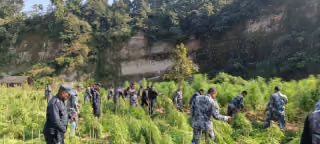
Nepal Police, the Armed Police Force and the Nepal Army destroyed naturally growing cannabis around Khalanga, the headquarters of Jumla district, on Saturday 21 August 2021. Police put the area cleared at about three bighas, roughly two hectares, and said the operation was the start of a district-wide drive against wild cannabis that young people had begun smoking.
Security personnel destroyed cannabis growing around Khalanga, the headquarters
of Jumla district.[1]A joint team of Nepal Police, the Armed Police Force and
the Nepal Army carried out the clearing.[1]According to the District Police
Office, Jumla, the plants were destroyed near Chandannath Temple at Sela Jiulo,
the bus park, Bhartibada, Hospital Line and Jugadkhola.[1]Chief District
Officer Bijayakumari Prasai went to the site, and local people joined the
security personnel in pulling down the plants.[1]
Deputy Superintendent of Police Dan Bahadur Thapa said the team destroyed about
three bighas of cannabis on the Saturday.[2]Thapa said cannabis is not
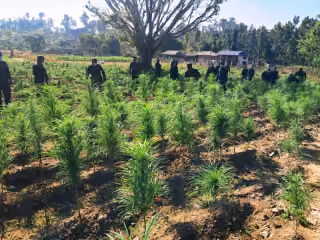
cultivated in Jumla but grows naturally in the fields.[3]He said local youths
had started smoking it and that rising use came with more criminal activity, so
officers were told to destroy all the cannabis they could find.[1]Police said
one well-grown plant yields half a kilogram to a kilogram of prepared cannabis.[3]Traders carry processed cannabis to the Indian market, where police said it
sells for up to 11,000 Indian rupees a kilogram.[1]
The District Police Office, Jumla, said it had instructed police posts and units
across the district to destroy cannabis.[3]Ward representatives, civil
society and political party representatives were to take part in the clearing at
every local level.[4]Police acted in the first week of Bhadra, the Nepali
month that runs from mid-August to mid-September, before the crop matured.[3]Cannabis matures from the second or third week of Bhadra, when traders collect
the plants to make the drug.[3]
Photos and video
Security personnel in camouflage among tall cannabis plants, in the lead photo published with the report on the Jumla clearing.Photo details
No count of the cannabis plants or weight of the drug destroyed was published, only the area of land cleared.
The English report is dated Sunday 22 August 2021 and the Nepali reports 5 and 6 Bhadra 2078; the destruction itself was on Saturday 21 August.
The accounts repeat the District Police Office, Jumla's statement, and Republica and Nagarik News are both published by Nepal Republic Media, so they are not independent.
The hectares figure is converted from the stated three bighas at the standard Nepali bigha of about 0.677 hectares.
No arrests, charges or court action over the destroyed plants were reported.
The figure of up to 11,000 Indian rupees a kilogram is a market price for processed cannabis in India quoted by police, not a valuation of this clearing.
Bhojpur District Police said on 21 June 2026 that a fiscal-year anti-cannabis campaign had uprooted 130,485 mature plants and 8,550 saplings, arrested 14 people and destroyed 1,556 kg of processed marijuana. Three were accused of cultivation and sale and 11 of transport and storage.
Arrested 14Charged 14Plants destroyed 139,035Cannabis 1.556 t
A joint Nepal Police and Armed Police Force team uprooted and destroyed more than 180,000 cannabis plants on over 35 bighas of land in the Chure region of Lalbandi Municipality, Sarlahi. Police said security agencies had cleared more than 70 bighas of illegal cultivation in the district's Chure belt and were investigating who grew the crop.
A joint Nepal Police and Armed Police Force team uprooted about 18,500 cannabis plants on roughly three and a half bighas of land at Pipal Damar in Ishworpur Municipality-12, Sarlahi, on 12 December 2025. Officers acted as the crop neared harvest, and local residents who grow cannabis there for income disputed how the drives are run.
Police destroyed cannabis planted on 46 bigha and 16 katta of land in Raksirang and Kailash rural municipalities of Makwanpur district, along with an opium plantation, and said the clearing took four consecutive days. Three police teams took part, and locals said the annual campaign had not stopped cultivation.