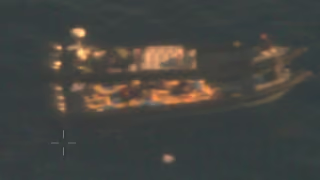
Portugal’s National Republican Guard (GNR) arrested seven people and seized more than five tonnes of hashish during a major anti-drug operation along the Guadiana river in the eastern Algarve.[1] The operation was carried out on Saturday 22 August 2026 in Vila Real de Santo António and Castro Marim, after Spain’s Guardia Civil detected suspicious activity near Corte Velha, in the Azinhal area.[1] The GNR launched a coastal surveillance operation involving land, sea and air resources to intercept those involved and prevent suspected drug trafficking by sea.[1] The movements were detected opposite Costa Esuri, a development on the Spanish bank of the Guadiana.[2] The drugs were found near ruins in the Corte Velha area of Azinhal, on Portuguese territory.[2]
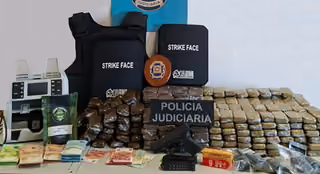
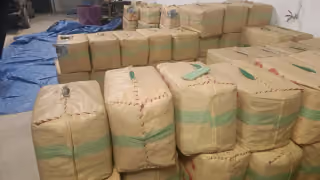
Several suspects noticed the presence of police and attempted to flee, initially on foot and later using a car and a boat.[1] The car was intercepted with no one inside, while maritime units caught up with the fleeing boat and arrested seven men aged between 21 and 39, all foreign nationals.[1] Another man believed to be linked to the operation was identified.[1] The GNR said officers seized cannabis resin amounting to approximately 5.32 tonnes of hashish.[1] Police also seized three vehicles, two boats, a pistol with a magazine and ammunition, six mobile phones and more than €1,000 in cash.[1]
On Friday night, a GNR maritime patrol had tried to approach a suspicious vessel linked to the operation; its occupants reacted with hostility and tried to ram the patrol before fleeing towards the Canela estuary in Spanish territory.[3] Officers prevented the manoeuvre, and the suspects fled on foot at Ayamonte marina, where the boat was seized.[3]
Saturday’s operation involved officers from the GNR’s Coastal and Border Control Unit, the Faro Territorial Command and the Intervention Unit, with support from Spain’s Guardia Civil.[1] The operation was carried out by the Vila Real de Santo António coastal control sub-detachment of the GNR’s Coastal and Border Control Unit (UCCF).[3] On Monday 24 August, a judge at the Vila Real de Santo António court ordered pre-trial detention, the most severe coercive measure in Portuguese law, for all seven after a first judicial interrogation.[2]