5,800 ropanis of cannabis destroyed in Gokarneshwor, Kathmandu
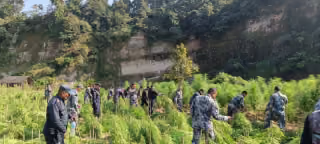
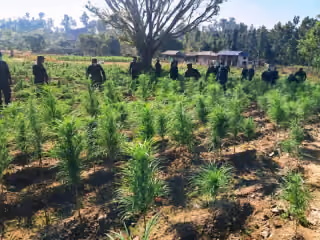
Nepal's Narcotics Control Bureau and Armed Police Force destroyed cannabis grown across around 5,800 ropanis in Gokarneshwor Municipality-1 near Kathmandu, taking three days to clear it. Police said they destroy reported crops and warn farmers, while traffickers lure growers with better returns and advance payments.
🇳🇵 Okhreni, Chilaune, Gaurigaun, Majhgaun, Kune and Khatritole, Gokarneshwor Municipality-1, Kathmandu · Nepal
The Narcotics Control Bureau and the Armed Police Force destroyed cannabis
plants cultivated on the outskirts of Kathmandu.[1]An 80-person team
destroyed cannabis illegally grown by local people in Okhreni, Chilaune,
Gaurigaun, Majhgaun, Kune and Khatritole of Gokarneshwor Municipality-1.[1]Officials said it took the team three days to clear cannabis grown across around
5,800 ropanis of land, about 295 hectares.[1]
On June 8 the bureau had destroyed cannabis on more than 1,700 ropanis in the
same municipality, about 86.5 hectares.[1]Police said they destroy reported
cannabis crops and warn farmers not to repeat the illicit cultivation.[1]In
some cases drug traffickers were found to have been involved in cannabis
cultivation.[1]They lure farmers to cultivate cannabis for food crops
promising better returns.[1]Drug traffickers were reported to make advance
payments to farmers to facilitate cultivation of the illegal plants.[1]
According to the bureau, cannabis cultivation and its natural growth are posing
a threat to its anti-drug initiative.[1]The trend of cannabis cultivation was
described as on the rise in Nepal as people are lured into making quick money.[1]It was described as gaining ground on the fringes of the Kathmandu Valley.[1]Security personnel were described as destroying cannabis plants to
discourage drug traders.[1]The destruction was also aimed at controlling drug
abuse among local youths.[1]
Case data
Every number and detail the sources state, with the sources that state it.
No calendar dates are given for the three-day operation; 16 June 2019 is the article's Kathmandu dateline and is used as an approximate incident date, with 17 June 2019 as publication.
No plant count, seized weight, or value estimate was published; the only scale given is the cultivated area.
The hectares figure covers only the recent 5,800-ropani clearance; the more than 1,700 ropanis cleared on June 8 is described separately and is not added to the total.
Hectares are converted at 1 ropani = 508.74 sq m, so around 5,800 ropanis is about 295 hectares and more than 1,700 ropanis is about 86.5 hectares; both source areas are stated as approximate.
The account does not separate planted cannabis from natural growth when describing the threat to the anti-drug initiative.
The wider claim about cannabis and opium cultivation becoming widespread does not give a separable cannabis weight or area, and opium is not counted in the cannabis figures.
No arrests, charges, detentions, or court outcomes were reported, and no farmers were named.
No second independent account of this Gokarneshwor operation was found; the report rests on the single opened article's account of the bureau's information.
Bhojpur District Police said on 21 June 2026 that a fiscal-year anti-cannabis campaign had uprooted 130,485 mature plants and 8,550 saplings, arrested 14 people and destroyed 1,556 kg of processed marijuana. Three were accused of cultivation and sale and 11 of transport and storage.
Arrested 14Charged 14Plants destroyed 139,035Cannabis 1.556 t
A joint Nepal Police and Armed Police Force team uprooted and destroyed more than 180,000 cannabis plants on over 35 bighas of land in the Chure region of Lalbandi Municipality, Sarlahi. Police said security agencies had cleared more than 70 bighas of illegal cultivation in the district's Chure belt and were investigating who grew the crop.
A joint Nepal Police and Armed Police Force team uprooted about 18,500 cannabis plants on roughly three and a half bighas of land at Pipal Damar in Ishworpur Municipality-12, Sarlahi, on 12 December 2025. Officers acted as the crop neared harvest, and local residents who grow cannabis there for income disputed how the drives are run.
Police destroyed cannabis planted on 46 bigha and 16 katta of land in Raksirang and Kailash rural municipalities of Makwanpur district, along with an opium plantation, and said the clearing took four consecutive days. Three police teams took part, and locals said the annual campaign had not stopped cultivation.