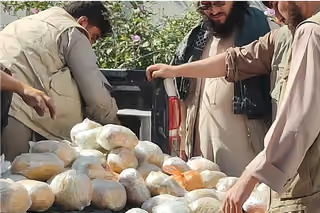
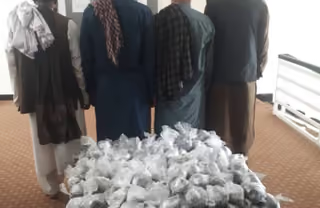
The October operation targeted the obscure Hadimama drug trafficking network led by Abdul Rahman and Haji Janan, who were believed to be producing heroin in the labs to fund insurgent activities.[1] A Green Beret A-team aided the agents in executing a warrant search in western Afghanistan, and after a brief gunfight with insurgents near the compound outside a remote village the teams found tons of chemicals in a superlab used to process poppy into heroin base.[1] A joint U.S. Drug Enforcement Administration, American Special Forces and Afghan counter-narcotics operation in October resulted in a 20-ton drug seizure described as the largest known heroin seizure in Afghanistan if not the world.[1] The October 17 raid took place in the western Afghan province of Farah on the border with Iran.[1]
Officers seized 12 kilograms of hashish as the separately stated cannabis component.[2] The same seizure included 12.5 tons of morphine base, 6.4 tons of heroin base, 134 kilograms of opium and 129 kilograms of crystal heroin.[1] The Drug Enforcement Administration gave a conservative estimated street value of about $60 million for the combined haul.[1] Besides the drugs and chemicals, the teams seized nine motorcycles and five AK-47 rifles.[1] Agents described the superlab as complex, sophisticated and well fortified, apparently the first of its kind seen in Afghanistan.[1]
Drug Enforcement Administration spokesman Steven Bell said the seizure prevented heroin reaching streets worldwide and denied the Taliban money for insurgent activities in and around the region.[1] Afghanistan remained the world’s number one supplier of heroin, and a United Nations report released in October said its opium harvest had increased 43 percent over the previous year’s crop.[1] The operation was kept under wraps until a Drug Enforcement Administration official confirmed the contents of a field intelligence report obtained by ABC News, without explaining why the superlab takedown was not officially announced.[1]