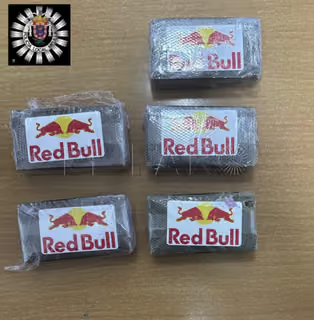
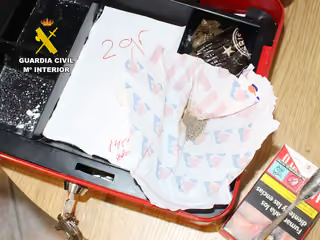
Guardia Civil officers detained a man in Escucha as the suspected perpetrator of a drug-trafficking offence after catching him with 3,651 g of pressed hashish resin.[1][2] The detention took place during a crime-prevention and public-security operation set up in the town of Escucha.[1] The man was driving a van made to look commercial so that it would not raise suspicion on the road.[1] The van was an Opel Combo stopped on the N-420a road near Escucha.[2] Officers stopped and identified the driver, checked the vehicle, found several irregularities and searched it.[1][2] In the rear cargo area, sheets and a dark mat covered a trapdoor cut into the floor and a hidden compartment.[1][2] Preliminary tests on the ten blocks gave a positive result for cannabis derivatives, and the definitive laboratory analysis is still pending.[2][3] Inside were ten compact blocks of pressed hashish resin, labelled commercially and divided into batches, weighing 3,651 kg.[1] Escucha lies in the Cuencas Mineras district of Teruel province.[4]
The Guardia Civil placed him and the seized drugs at the disposal of the Juzgado de lo Penal number 3 in Teruel.[5] He appeared before a judge on 11 November.[6] The judge ordered him held in provisional prison without bail, the court’s press office said.[7][2] The accused exercised his right not to declare, his defence asked for his release, and the prosecution asked for him to be held in prison without bail.[2] The defence argued that there were insufficient indications against him and proposed measures less restrictive than imprisonment.[3] The order concerned drug trafficking in a quantity of notorious importance, a Spanish legal category.[7] The order was issued by judge Manuel Turmo Peña of seat number 2 of the Civil and Instruction Section of the Tribunal de Instancia de Teruel.[2] The judge said there were rational indications and reasons to consider him responsible.[7] The order notes that the quantity seized exceeds the 2.5 kg jurisprudential reference for hashish, which could raise the sentence to between three years and a day and four years and six months in prison.[2][3]
A Málaga court had convicted him on 27 August 2026 of drug trafficking and given him eight months in prison, suspended for two years, the judge noted.[7][2][3] The judge said the detention would avert the risk of flight and of further offences.[7] The order cited flight risk from the possible penalty and the chance that a new conviction could overturn the earlier suspension; although R. L. listed a domicile in Vélez, Málaga, the court lacked information on his residential stability, work or family ties.[3] The order can be appealed within three days for reform and five for appeal.[7][3]