PRF seizes 5.8 tonnes of skunk in Corumbá region, more than cocaine
Federal Highway Police data for January to October 2026 show 5,841.092 kg of skunk seized in the Corumbá region, Mato Grosso do Sul, ahead of 3,519.711 kg of cocaine, 368.910 kg of marijuana and 100.350 kg of hashish. An officer of the force said skunk had already led the region's seizures in 2024 and 2025, and that the cannabis appears to be arriving across the Bolivian border.
Federal Highway Police data for the first ten months of 2026 show skunk, a
cannabis variety with a higher THC concentration, overtaking cocaine to lead the
volume of drugs seized in the Corumbá region.[1]Between January and October
the force recorded 193 occurrences related to drug trafficking in its area of
operation.[1]Officers seized 5,841.092 kg of skunk in the period, about 5.8
tonnes, against 3,519.711 kg of cocaine, 368.910 kg of marijuana and 100.350 kg
of hashish.[1]
Alexandre Luiz Zortea, institutional communication officer of the 3rd PRF
station in Corumbá, said cocaine had historically led seizures in the region but
that the numbers changed in the last three years.[1]Zortea said skunk had
already taken first place among seized drugs in 2024 and 2025, a trend
continuing in 2026.[1]One hypothesis he gave is that Bolivia, long a cocaine
producer, has expanded production of the cannabis the force finds coming in
across the Bolivian border, though he said no studies prove it.[1]
The force’s area lies on the border with Bolivia, which the report describes as
a corridor for drugs bound for other parts of Brazil, checked on highways
including BR-262 and the Bioceanic route by the PRF, Federal Police, Military
Police and Receita Federal.[1]
Photos and video
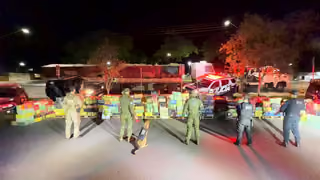
Federal Highway Police handout photo of seized skunk and cocaine, captioned as 543 kg of skunk and 431 kg of cocaine. Photo: Divulgação/PRFPhoto details
Original
753 × 396 px · JPEG · 116 KB
SHA-256
7a1f904789843169…
Retrieved
7 Nov 2026
Shown
the publisher's file, through an image proxy
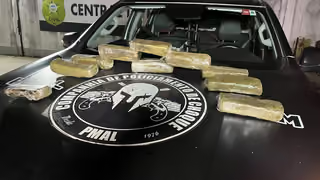
Source: Diário CorumbaenseFederal Highway Police handout photo of cocaine paste and skunk, published with the PRF seizure balance for the Corumbá region. Photo: Divulgação/PRFPhoto details
The article does not name a cut-off day within October; 31 October 2026 is used as the end of the period.
No separate PRF statement or second outlet reporting this balance could be opened, so the figures rest on one account that says it requested the data.
The 193 trafficking occurrences, 159 detentions for other crimes and recovered vehicle totals are not broken down by drug, so no arrested figure is recorded for cannabis.
The photographs show seizures police call the region's largest so far, 543 kg of skunk and 431 kg of cocaine, but the article does not date that seizure or place it beyond the caption.
No breakdown of the 5,841.092 kg by single seizure, highway, origin or destination was published.
Paraná's Border Police Battalion and federal agencies seized 7,781 kg of marijuana and skunk hidden in a maize load on a bitrem truck stopped on BR-163 near Marechal Cândido Rondon, and arrested a 30-year-old man and a 20-year-old woman. The operation, part of Operação Protetor, ran from 10 to 11 November 2026, and the battalion put the loss to organised crime at R$16,318,000.
Military Police in Lajinha found 58 marijuana tablets hidden in a stove in an abandoned house on 10 November 2026 and seized 62 tablets in all. A 20-year-old was arrested and a 17-year-old was taken into custody, and both were taken to the Civil Police station in Manhuaçu.
Federal Highway Police officers seized a load of marijuana hidden inside two fiberglass boats transported in a box truck during an inspection on the BR-277 in Cascavel, Paraná. The driver was released after showing he was unaware of the drugs, which were on their way from Missal to Rio de Janeiro.
Shock Company officers seized about 10 kg of marijuana hidden in scrubland in Pescaria, on Maceio's northern coast, after an anonymous tip during a patrol. The drugs were taken to the Central de Flagrantes, and no arrests were reported.