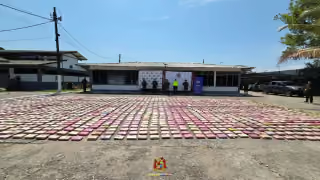
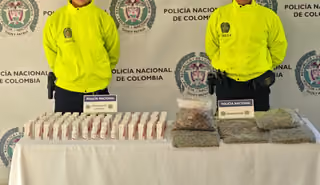
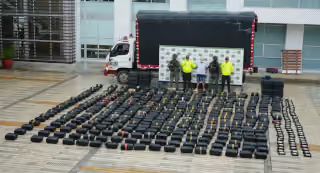
Colombian police intercepted a vehicle in the urban area of Chinchiná, Caldas, carrying 520 kilograms of marijuana and arrested one person caught in the act.[1][2][3][4] During the procedure one person was captured in flagrante delicto.[1][2] Officers also immobilised the vehicle, whose identification systems had been altered.[1][2][3][5] The man was handed to the judicial authorities and is to answer for the alleged crime of trafficking, manufacturing or carrying narcotics.[3] A check of judicial information systems found the detainee had an investigative annotation as an alleged firearms manufacturing, trafficking or possession offender.[4] The Caldas police department announced the arrest of the 32-year-old man and the seizure of the vehicle.[6] Officers first tried to stop the vehicle near Chinchiná’s main park during prevention and control work, but the driver ignored the order and fled.[3]
In his own statement the president said the marijuana had left the department of Cauca bound for Medellín.[7][8][2] President Abelardo de la Espriella announced the Chinchiná seizure and a second operation at the port of Cartagena.[9] The load was valued by police at more than 300 million pesos on the illegal market.[3]
The government presented the two hauls as 878 kilograms in total, of which 520 were marijuana and 358 cocaine.[9][10][11][12]
For the whole pair of operations the authorities reported one person arrested, in the Caldas procedure.[1] The Cartagena operation, named Estrategia Esmeralda, found the cocaine inside two electricity generators carried in a shipping container.[1][12]
After a cordon-and-search plan, known in Colombia as a plan candado, patrols intercepted the vehicle in the La Paz neighbourhood.[3][4] A search of the vehicle found 111 plastic-wrapped parcels containing the marijuana.[3][4]