Bolivia says 31 suitcases from US held altered marijuana; 70 kg seized in raid
Bolivia's interior minister said the more than 30 suitcases flown from the United States to Viru Viru airport in November 2025 carried altered marijuana intended for the high-priced Brazilian market. A January search of property linked to former judge Hebert Zeballos did not find the suitcases but seized 70 kilograms of marijuana.
🇧🇴 Santa Cruz de la Sierra, Santa Cruz department, Bolivia
Bolivia’s interior minister, Marco Antonio Oviedo, said the more than 30
suitcases flown into the country from the United States in November 2025 carried
chemically altered marijuana that would fetch a high price in Brazil.[1][2][3][4][5]After
nearly a year, the authorities say they still do not know what became of the
drug once it entered Bolivia.[1]
The suitcases arrived at Viru Viru airport in Santa Cruz de la Sierra on 29
November 2025 on a private aircraft from the United States.[1][3]Oviedo said the
pilot was ordered to divert to San Ramón airport in Santa Cruz department,
refused, and landed at Viru Viru, and that the luggage was cleared the next day
as diplomatic baggage.[1]
The former deputy Laura Rojas, an accused in the case, said in an expanded
statement that the owner of the suitcases was Supreme Court president Romer
Saucedo, known as El Alemán.[1][6][4]The former judge Hebert Zeballos then said the
suitcases held high-concentration marijuana produced in California and had the
protection of the then attorney general Roger Mariaca.[1][6][7][4][5]
The suitcases were taken to property belonging to Zeballos, where their trail
was lost.[1]When prosecutors took up the case in January, the property was
searched under prosecutor Delmy Guzmán and the suitcases were not found, but 70
kilograms of marijuana were seized.[1]
Oviedo named Mariaca and Saucedo the main authors of the operation, saying
Mariaca organised the flight and financed the contents of the suitcases while
Saucedo provided protection to those involved.[1][2]The minister said there was
still no information on how the marijuana was sold and that the investigation
now rests with the Public Ministry and the courts.[1][5]
Oviedo also said a third person, prosecutor Delmy Guzmán, intervened when police
tried to search the airport depot where the suitcases were left.[8][2]According
to Oviedo, former deputy Laura Rojas and former judge Hebert Zeballos collected
the suitcases the next day through a company belonging to Zeballos.[8][2]Mariaca
is held in preventive detention in Cantumarca prison while Saucedo has left
Bolivia and his whereabouts are unknown.[9][4]
Vice-Minister of the Interior Peter Maldonado said Juan Carlos Espinoza Vaca, described as an alleged frontman for the organization, died while detained in Palmasola prison.[2][3]Maldonado said doubts remain about the circumstances of that death and announced an investigation to clarify the cause and determine whether there are linked responsibilities.[2][3]
Zeballos said he did not know that the owner was Romer Saucedo and that he doubted Rojas’s version because the person he spoke to told him the suitcases had Mariaca’s protection.[6]
Case data
Every number and detail the sources state, with the sources that state it.
Cannabis
70 kg
Agency
Ministerio de Gobierno
Agency type
Police, Prosecutor
Cannabis
Herbal cannabis (70 kg)
Activity
Smuggling, Trafficking
Setting
Airport, Home
Case stage
Under investigation
Region
Santa Cruz
Route
United States → Bolivia
Date
Publication date
Sources
Visión 360vision360.boESGobierno asegura que en las maletas venía marihuana alterada de alto costo en Brasil; se desconoce su destino final
La Razónlarazon.boESOviedo: Las maletas contenían marihuana químicamente alterada
Los Tiemposlostiempos.comESOviedo revela que las maletas "contenían marihuana químicamente alterada que tiene un valor muy alto"
Open questions the AI reported
The article does not date the January search that seized the 70 kilograms; 6 November 2026 is the publication date of the minister's press conference and is used as the incident date.
No figure for the weight of the marijuana in the more than 30 suitcases was published; only the 70 kilograms found in the January search is counted.
The accounts disagree on the intended market: the minister said the drug would have a very high value in Brazil while saying its final destination is unknown.
Accounts differ on how many suitcases arrived and on where they left from: the minister and reporting say more than 30 from the United States, some say 31 or 32 from California, and one source says Rojas brought them from Miami.
The sources differ on where the pilot was ordered to divert: Visión 360 places San Ramón airport in Santa Cruz department, while ABI places it in Beni department; it is not recorded here.
Zeballos first said the protection came from Roger Mariaca and doubted that El Alemán was Saucedo, then corrected himself, according to ANF; Visión 360 reports only one version.
Oviedo called the marijuana chemically altered and called the group a narco-structure, but no laboratory result, chemical composition or weight for the suitcase contents was published.
No charges, arrests or court step tied specifically to this cannabis seizure were reported; Mariaca and Saucedo are detained or at large in the wider case.
The page photo shows the minister at an earlier press appearance and does not depict the suitcases or the seizure, so it is not listed as media.
This account gives no weight for the marijuana said to have been in the 31 suitcases, so the existing figure of 70 kilograms from the January search stands.
Zeballos's accusations against Mariaca and Saucedo still had to be contrasted and verified by the Fiscalía.
Zeballos's statements are his version of events and still need to be contrasted by the investigating authorities.
Red Uno gives no weight, volume or laboratory result for the marijuana said to have been in the suitcases.
The article's lead says 31 suitcases while another line says more than 30 arrived from the United States on a charter flight.
The minister's account rests on accused people's statements and on his own version; this article cites no forensic record, customs record or payment trail.
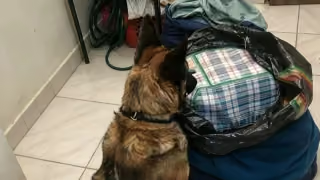
Felcn's detector dog Lía alerted on two bags in the parcel store of an interprovincial transport company in southern Cochabamba. Officers found 42 vacuum-sealed packages that tested positive for marijuana. No weight or arrest was reported.
Police and prosecutors in Bermejo seized 42.2 kg of marijuana plus 4 grams of cocaine from a vehicle that tried to evade a checkpoint. Four people were charged, with two in preventive detention and two under house arrest, a split the prosecution has appealed.
Bolivia's anti-drug force FELCN seized 18 packages of marijuana from an international bus luggage compartment at the Terminal Bimodal in Santa Cruz and another 10 packages testing positive for marijuana and cocaine base paste from a vehicle near San Ignacio de Velasco. The force opened investigations into the shipments without releasing their weight or saying whether anyone was detained.
Bolivia's anti-narcotics force found 840 packages of marijuana, packed in 30 jute sacks, near the Ollagüe volcano in Potosí department, and detained one person. The force said field tests confirmed marijuana and sent the case to prosecutors.