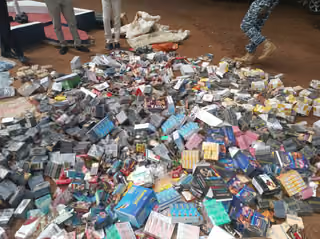
49 arrested as Bangui anti-drug office seizes 40 kg of cannabis
Central African Republic's anti-drug office seized 40 kilograms of cannabis in five Bangui neighbourhoods on 27 February 2013, during an operation it called "coup de poing". Officers arrested 49 people, 29 Congolese women and 20 Congolese and Central African men, and said they had started proceedings to bring them before Bangui's high court.
🇨🇫 Km5, Fodé, Bibalé, Miskine and Mamadou-Mbaïki, Bangui · Central African Republic
Officers of the Central African Republic’s anti-drug office, the Office
centrafricaine de lutte anti drogue (OCLAD), seized40 kilograms of cannabis in
Bangui on Wednesday 27 February 2013.[1]The seizure came during an operation
the office called “coup de poing”, a French phrase for a sudden strike.[1]In
the same operation police arrested 49 people for trafficking the drug: 29
Congolese women and 20 men of Congolese and Central African nationality.[1]
The operation covered the Bangui neighbourhoods of Km5, Fodé, Bibalé, Miskine
and Mamadou-Mbaïki, the last two written Mamadou-Mbaïki in the account; Mamadou
is a separate neighbourhood.[1]The officer commanding the operation said his
teams had carried out house searches and made incidental seizures.[1]The
police commander said the operation also turned up other drugs besides the
chanvre indien, the French term for Indian hemp, or cannabis.[1]
The raids followed complaints residents of those neighbourhoods made to local
media about growing insecurity they blamed on the arrested men.[1]The
operation commander said proceedings were already under way to bring the
detainees before the Bangui high court (tribunal de grande instance), the city’s
court of first instance.[1]
Case data
Every number and detail the sources state, with the sources that state it.
The 40 kilograms is described only as cannabis; the article does not say whether it was dried herb or resin, or where within the operation it was found.
The article also mentions other unspecified 'stupéfiants' seized but gives no quantities, so no separate figures for other drugs are recorded.
No details were published on the individual suspects, the charges filed or the outcome of the case before the Bangui tribunal de grande instance.
Only one accessible account of the operation, the RJDH-CENTRAFRIQUE report, was found; it is a local journalist network's account based on the operation commander's statement.
The article names the last district Mamadou-Mbaïki, which may combine the Mamadou and Mbaïki neighbourhood names; the report keeps the article's spelling.
The article does not say whether the operation ran over one day or several, though it gives Wednesday 27 February 2013 as the date of the seizure.
Cannabis loaded as freight at Bangui M'Poko International Airport on an Ethiopian Airlines flight was discovered when the shipment reached India, prompting inquiries between Indian authorities, the airline and its Bangui station. Corbeau News Centrafrique names freight and customs staff in the control chain; no arrests or court case were reported.
The anti-drug office destroyed seized cannabis and other products after operations along the Oubangui river, in Boy-Rabe and at Combattant market. Radio Ndeke Luka reported that the seizures took place from 14 to 20 October, before the destruction on 5 November.
A joint security operation in Ouandago had led to eleven arrests and the seizure of eleven homemade weapons and over ten kilograms of cannabis, MINUSCA reported. The operation responded to abuses by a self-defence group; the figures were a mid-operation report.
An anti-drug unit backed by the OCRB searched a former Anti-Balaka leader's home in Bangui's Combattant quarter on 6 November 2020, finding 15 sacks of cannabis herb weighing 125.5 kg and over a hundred war cartridges, and arrested two relatives. The OCLAD said it would seek a prosecutor's order to incinerate the cannabis.