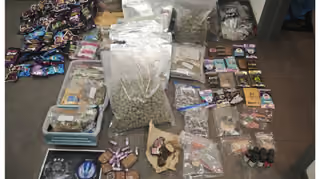
Record 19,339 kg of cannabis seized at Antwerp in 2025
Belgian customs intercepted a record 19,339 kg of cannabis at the Port of Antwerp between January and November 2025 across 13 operations, mostly from Canada, dwarfing the 336 kg seized in all of 2024.
Belgian customs intercepted 19,339 kg of cannabis at the Port of Antwerp
between January and early November 2025, a record that dwarfed the 336 kgseized in all of 2024.[1][2]Officers made the seizures across 13 operations,
four of them involving hauls of more than three tonnes each; twelve of the
shipments came from Canada and one from Thailand.[1][2][3]Customs figures later
put the full-year 2025 marijuana total at 21 tonnes, alongside nearly 55
tonnes of cocaine.[4][5][6]
Finance spokesman Francis Adyns said most shipments arrive by sea through
Antwerp, largely from Canada, but also by air cargo, courier and postal
services and in passengers’ luggage.[1]National drug coordinator Charlotte
Colman linked the flow to overproduction in countries that legalised cannabis
for their domestic markets, with surplus diverted into international
trafficking.[1]Canada, the United States and Thailand have legalised
cannabis to varying degrees, but only for domestic markets.[1][2]
Belgian authorities recorded a marked rise in smuggling of the drug since Canada legalised cannabis in 2018.[6]Once inside Europe, the cannabis can be sold for nearly 10 times its price, depending on the location, since cannabis remains illegal in most European Union countries.[6]Customs found the shipments hidden in a container of a family’s personal effects, in gutted bran crates fitted out inside, and in vacuum-packed, labelled bags sent by sea.[6]Only 1 to 2 per cent of containers at Antwerp are inspected, using sniffer dogs, scanners, artificial intelligence or staff intuition.[6]The port handles 13.5 million containers a year.[6]Belgium appointed Ine Van Wymersch as commissioner in charge of the fight against drugs, and she asked Canada for closer cooperation on the problem she called glocal.[6]Europol said the profitability of North American cannabis, due to its high potency and low production cost, combined with European demand, “guarantees that this illicit trade will probably persist”.[6]
Case data
Every number and detail the sources state, with the sources that state it.
No arrests or charges from the 13 operations were reported.
No breakdown of the individual operations was published beyond four hauls exceeding three tonnes each.
Customs later put the full-year 2025 marijuana total at 21 tonnes, leaving the December addition unexplained.
CNNBS does not mention the accompanying nearly 55 tonnes of cocaine in the cited existing sentence.
The RTBF feature puts the 2025 all-borders cannabis total at more than 27 tonnes, a wider scope than the Antwerp-only 19,339 kg total in this report.
Radio-Canada gives only the full-year 2025 total for Antwerp and does not date any individual seizure, so the report's date remains the one already used for the yearly total.
The 21 tonnes are attributed to Canadian-origin cannabis only; it is not stated whether other cannabis intercepted at Antwerp in 2025 is included.
The page's 21-tonne figure is Canadian-origin cannabis, while the report's separate 19,339 kg figure covered 13 operations between January and early November 2025; this source does not reconcile the two totals.
A prisoner at Marneffe returned from temporary leave with 7 grams of cannabis he had obtained while away. Prison guards quickly found it during a search, and the prisoner said he needed it to sleep.
Police in the Bruxelles-Ouest zone seized 13.53 kg of cannabis and 8,670 euros in cash from an apartment in Jette after stopping a scooter rider on avenue de l'Exposition, and detained two suspects handed to the Brussels prosecutor's office.
Operation ATLAS NEXUS, led by Belgium's Federal Police and co-coordinated by Frontex, EMPACT and CARICOM IMPACS across 34 countries, ended with more than 490 arrests and the seizure of 118.6 tonnes of cannabis among 156.9 tonnes of drugs. National operations included a record 104.96 tonnes of cannabis in Paraguay and 3.2 tonnes in Costa Rica.
Brussels federal judicial police seized more than 500 kg of cannabis hidden in two Canada-origin pallets declared as clothing, arresting eight people on 27 August 2026. Four were remanded under arrest warrant, with vehicles, a jammer and phones also seized as the inquiry into the import network continues.