The Audiencia Provincial de Almería cut by €270,982 the fine on a man who grew marijuana to sell in the city, reducing it from €350,000 to €79,018 while keeping his two-and-a-half-year prison term for a public-health offence of notoria importancia (a quantity threshold that aggravates the sentence).[1] The court partly upheld the convict’s appeal and also lowered the fines for electricity fraud and usurpation.[1] It sided with the other defendant, who had been cleared of all charges and appealed to recover the Audi that the first-instance ruling had ordered confiscated, and ordered the car returned without charging the costs of its seizure.[1]
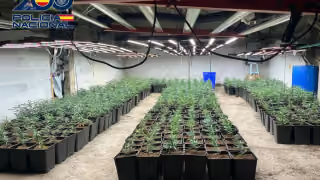
The Policía Nacional seized 2,722 plants and 208 cuttings in the operation behind the case.[1] The searches took place on 12 April 2023 at six properties in Almería, four holding plants, cuttings or drying material, along with lamps, transformers, extractors and air conditioners.[1] At the other two properties officers seized, among other items, €1,410 in cash, two electric scooters, two mobile phones, a bicycle, a scale and a piece of bud.[1] Analysis of the drugs gave 73.18 kg of cannabis and a further 7.76 kg of leaves at net dry weight, and the judgment put the substance’s value on the black market at about €158,038.[1] The four cultivation properties had irregular electricity connections, two of them owned by Andalusia’s housing and rehabilitation agency and used without its consent.[1]
The court applied two mitigating circumstances already recognised at first instance — the man admitted the facts at the start of the trial and the case sat idle for over a year for reasons beyond the defendants’ control — and lowered the fines by one degree.[1] The electricity-fraud and usurpation fines fell to one month and 15 days each at €18 a day, from nine and six months.[1] It kept the two-and-a-half-year term as proportionate to the seizure, almost seven times the notoria-importancia threshold, and the difficulty of running the crops, and rejected a drug-dependency mitigation.[1] It found unproven the first-instance finding that the car was bought with drug money and used for trafficking, and that it belonged to the convict, accepting that the absolved woman was the owner, a position the prosecution fully backed.[1]